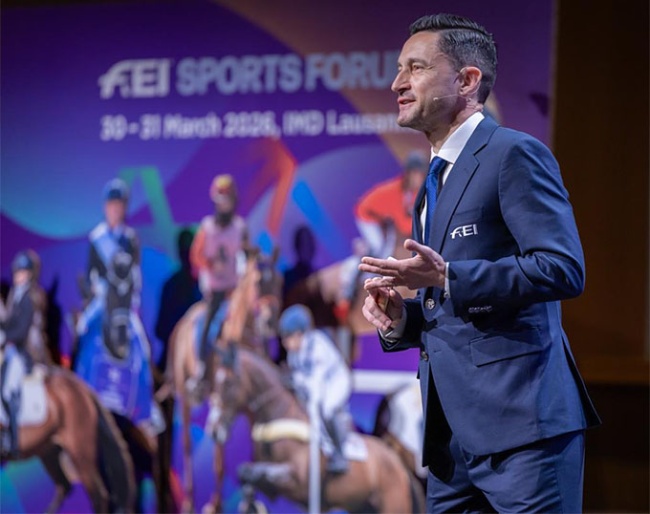
The second and final day of the FEI Sports Forum 2026 in Lausanne (SUI) opened with a dynamic session on the FEI Marketing and Communications Strategy 2026–2030.
François Vergnol, FEI Executive Director, Commercial, Marketing & Communications, delivered a comprehensive presentation that quickly sparked an engaging debate, with participants raising questions and ideas around social media, TV coverage, and collaboration with National Federations and stakeholders.
“In the attention economy, we compete not just with other sports, but with every form of entertainment — streaming, social media, gaming, podcasts, and more,” François Vergnol said. “Content consumption is evolving rapidly. Live TV remains important, but it’s no longer enough. Today, data drives success: understanding who our audiences are and what they truly want is critical. We want to carve out more free-to-air content so that we can quench the thirst of the new fan and also serve the super fan.”
Strategic Overview: Strengths, Challenges, and Opportunities
The FEI’s Marketing & Communications strategy was developed over four months with input from both internal and external stakeholders, including benchmarking support from global sports consultancy CAA Portas. Partner Peter Whight highlighted how the process combined a structured methodology, bringing external perspective, with full ownership retained by the FEI.
The analysis shows that equestrian sport has significant strengths – a global fan base of 220 million, up to 1.2 billion horse enthusiasts, a passionate community, and gender-equal competition alongside equine athletes – yet faces challenges from increasing competition for attention, shifting media consumption habits, and the growing importance of data-driven fan engagement.
Although live television remains relevant, it now forms just one part of a broader content ecosystem. In addition, with horse welfare a constant and central focus for the FEI, there is an important opportunity to communicate the ongoing work more transparently and widely.
Four Strategic Pillars
Vergnol then outlined the strategy, which is centered on four key objectives:
- To showcase the unique excellence of the sport, horses and athletes
The FEI aims to elevate both equine and human athletes, building stronger storytelling around their personalities, performances, and rivalries. Major events such as the FEI World Championships, Olympic and Paralympic Games will be positioned as flagship moments, supported by more consistent narratives across all FEI series to create a continuous and engaging storyline.
- To grow and engage a passionate, known equestrian community
The strategy targets both existing fans and new audiences, particularly younger generations. Initiatives include innovative digital content, such as non-branded platforms designed to attract horse lovers, higher focus on mobile-friendly authentic behind-the-scenes content and the development of a “Digital Stable” — a first-party data ecosystem offering fans personalised experiences, exclusive content, and commercial opportunities. This data-driven approach aims to convert engagement into measurable value for partners and the sport.
- To position the FEI as a trusted, modern and enabling International Federation
Transparency, particularly around integrity and horse welfare, will be central. The FEI plans to strengthen crisis response mechanisms, improve communication speed and quality, and enhance collaboration with National Federations through shared frameworks, early briefings, and coordinated campaigns.
- To grow understanding and trust in equestrian sport
This pillar focuses on demonstrating the positive lives of horses within the sport and reinforcing welfare standards through clear, evidence-based communication. It also includes a more proactive advocacy role, engaging with institutions and stakeholders on governance, and the broader societal impact of equestrian sport — from wellbeing benefits to economic contribution.
Execution and Measurement
Vergnol outlined that the strategy will be implemented through targeted initiatives and measurable outcomes.
Key performance indicators will include:
- Equestrian’s continued inclusion and performance within the Olympic and Paralympic programme;
- Growth in the FEI’s global fan base and participation in equestrian sports;
- TV and digital audience metrics;
- Feedback from National Federations;
- Public perception of equestrian sport.
During a vibrant and highly engaged discussion session, in which the youth participants played a central role in shaping the conversation, a wide range of constructive ideas were offered to strengthen and refine the strategy.
Key suggestions included:
- bringing the everyday care and welfare of horses more prominently into the spotlight across all platforms;
- enhancing support mechanisms for athletes and National Federations;
- further leveraging data to drive more effective and personalised fan engagement;
- increasing participation and visibility in underrepresented regions such as Asia, South America and Africa, in order to increase prominence in FEI communications activities and content with the aim of reducing barriers to entry for engaging younger audiences;
- broadening stakeholder engagement beyond National Federations to include MOU signatories, as well as exploring synergies with other equestrian disciplines such as racing to maximise crossover opportunities.
A strong emphasis was placed on improving communication around equine welfare, not only to the general public but also internally across stakeholders, ensuring greater transparency and understanding of ongoing initiatives.
“Proactively telling the story of the genuine care we provide for our equine athletes—embedded in the very fabric of the sport—is essential. It shows how we improve horses’ lives and inspires others to do the same,” concluded François Vergnol.
The idea of creating a centralised content portal was also put forward to enable stakeholders from across the community to contribute story ideas and support more coordinated storytelling efforts.
Overall, the discussion reflected confidence that the strategy is well-structured for delivery, supported by a clear FEI vision, a Commercial, Marketing & Communications (CMC) function aligned to its key pillars, and an evolving organisational structure designed to enable implementation.
In closing, François Vergnol reiterated that the success of the strategy will depend on strong collaboration across the entire equestrian community. The FEI will continue to refine the approach in the coming months, ahead of final validation by the FEI Board at the end of June.
Related Links
Full Revision of FEI Dressage Rules Takes Centre Stage at 2026 FEI Sports Forum
Youth in Focus at 2026 FEI Sports Forum: From Pony to Podium: Our Youth, Our Future