-- FN press release
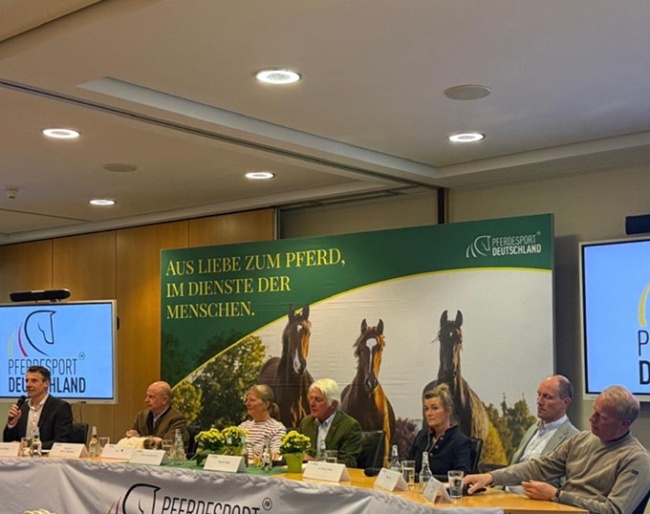
How early can a young horse start competing in equestrian sport and where does overexertion begin? This question is intensely discussed in the equestrian world. At the "Hot Topics" dialogue event hosted by the German equestrian federation (FN) in Warendorf on 12 May 2026 experts from sport, breeding, science, and training came together to discuss precisely this: the prerequisites, opportunities, and risks of starting competitions early – and how to balance training and responsibility.
PETA Cancels Participation
Under the title "How young is too young? Between encouragement and overexertion," riding master Martin Plewa, scientist Prof. Dr. Christine Aurich, veterinarian Dr. Kirsten Tönnies, Ingo Pape from the Pape stallion station, and Wilken Treu, managing director of the Hanoverian Association, discussed the topic.
The evening was moderated by Dr. Dennis Peiler, Chairman of the FN Board. The host was Prof. Dr. h.c. Martin Richenhagen, FN President.
Jana Hoger, representative of PETA, had to cancel her participation at short notice due to personal reasons.
Ignoring Criticism Not the Solution
Right at the start of the evening Martin Richenhagen emphasized that ignoring criticism was not the solution. Anyone who wanted to ensure the future of equestrian sport had to engage with critical voices. What was crucial was a factual exchange based on arguments, knowledge, and mutual respect. It wasn't about a completely different system. Rather, riders, trainers, judges, and organizers needed to be better equipped to recognize when a horse was being pushed beyond its limits, to read its behavior, and to act responsibly.
The central question in the discussion was how young horses can be to be introduced to the sport in an age-appropriate and responsible manner. It became clear that there is no one-size-fits-all answer. Crucial factors include the individual horse's development, its physical and mental resilience, its familiarity with the sport, a calm and patient training environment, its trust in humans, and its specific surroundings.
Early childhood education – scientifically re-evaluated
Professor Christine Aurich's research shows that early, moderate training is not harmful to young horses, but rather promotes their physical development and health. The widespread belief that horses should only be exercised once their growth plates have closed is considered outdated – similar to children, who also participate in sports and are not yet fully grown. It always comes down to moderation.
In addition to physical development, Aurich also examined mental resilience. The result: Horses can be carefully introduced to tasks from around 18 months of age. The stress response is individual and measurable, for example via heart rate or cortisol levels. It is striking that young horses often react with greater stress during transport than during physical work. According to Aurich, early, careful familiarization with new stimuli is beneficial. However, the right time for competitions depends heavily on the individual horse's development and how it is handled.
Individual paths instead of rigid rules
Ingo Pape advocated for an individualized approach to young horses. He emphasized that horses should not be forced into a rigid mold. Each horse possesses its own unique characteristics, abilities, and learning pace. The crucial factor, he stressed, is to correctly interpret each horse and find the right path for every individual animal. "Ten horses are ten different horses," as Paul Stecken famously said. "It is my responsibility to interpret my horses accordingly and find the right path for each one," Pape emphasized.
Wilken Treu emphasized, from a breeding perspective, that young horses must not be overtaxed during preparation and presentation. "Our goal is to create conditions that prevent overexertion, even during preparation." He believes that earlier competition can be beneficial, as long as it's done correctly. The crucial point, Treu continued, is to design requirements that remain age-appropriate and avoid physical strain at any age. "You can make mistakes at any age – both psychologically and physically. It's very easy to mentally overload a horse. Therefore, we need to examine this even more critically," warned the Hanoverian managing director. The entire industry must face this responsibility and work consistently to identify "bad apples" and improve the sport's image.
Training, Responsibility, and a Focus on Good Riding
Riding master Martin Plewa advocated for increased knowledge transfer and more consistent application of training principles. Health and well-being must be paramount. "I've learned that you never sit a young horse's trot – neither at the trot nor the canter. A young horse is ridden with short stirrups and its development is deliberately slow and gradual."
At the same time, Plewa believes that the eye for good riding needs to be cultivated. His idea: At the Bundeschampionate the test should be demonstrated before the riding horse tests. The demonstrators should show how a horse can be presented correctly and in a way that is appropriate for the horse. The rides should be commented on accordingly, in order to educate the audience as well. "That's a very good suggestion, which we will pursue," Dr. Dennis Peiler responded directly to the proposal.
Dr. Kirsten Tönnies emphasized the importance of positive reinforcement and a more conscious approach to young horses. She stressed that training and sporting success are not the same thing. Therefore, she argued, there needs to be more discussion about how learning processes should be structured to individually support each horse. She stressed the importance of a nuanced consideration of what is being discussed – the requirements, the conditions, and the circumstances. She expressed her desire for a more detailed examination of a horse's training path.
Further development as a shared mission
Dr. Dennis Peiler placed the discussion within the context of ongoing developments in equestrian sport in Germany. "The Young Horse Summit at the beginning of the year already provided important impetus, working groups have initiated concrete adjustments, and now the pilot project is being implemented in the riding horse classes at the Bundeschampionate."
The aim is to gather experience, evaluate measures, and refine them where further action is needed. The goal is to further develop requirements so that young horses are not overtaxed and are simultaneously prepared in the best possible way for their future sporting careers.
Conclusion
The evening in Warendorf made one thing clear: the question of the right time to start the competition season cannot be answered in general terms. Crucial is the responsible, individualized approach to each horse.
Formats like the "Hot Irons" debates create space for this – for exchange, for different perspectives, and for the joint development of equestrian sport.
Related Links
Oldenburg Moves Main Stallion Licensing to January 2023
Angelika Frömming on the Loss of Quality in Gaits Seen in the 7-YO Dressage Horse Class
Proposed Rule Changes at 2025 FEI General Assembly: Snaffles at 3* Grand Prix Level, Resistance in FOP, No Increase of Age for GP Horses
German Ministry of Agriculture Issues Guidelines for Welfare in Equestrian Sport, Denounces Rollkur and Hyperflexion