-- Text by David Stickland
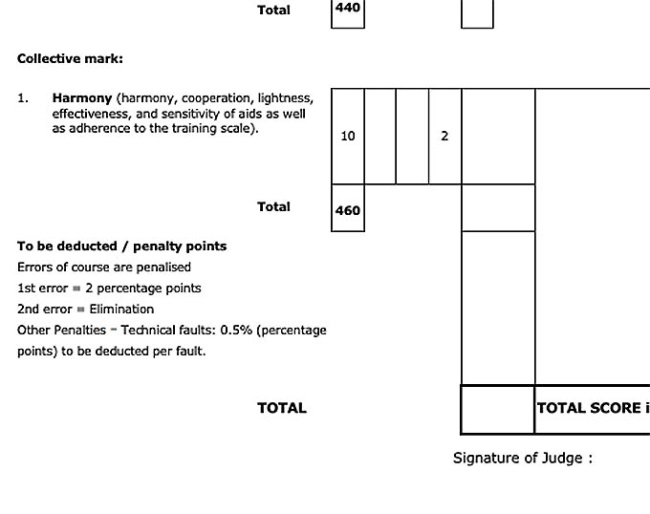
Once again collective marks are a topic of discussion and the rule change will be voted in at the General Assembly this week at the upcoming FEI General Assembly in Jiangyin (CHN), starting on 5 December 2026. The FEI Dressage Technical Committee has proposed a rule change, removing Article 423 Paragraph 9: Collective mark: After the Athlete has finished their performance, a collective mark is awarded for Harmony and demonstration of the Training Scale. The removal of collective marks from Dressage Tests, finally!
Too High a Cognitive Load to stay Objective
As someone who served on the Dressage Judging Working Group (DJWG) that submitted their conclusions in 2018 I wholeheartedly support this.
Before that there were four collective marks and it was the considered the opinion of the DJWG, based on analysis and presentations from external experts, that the cognitive load was too heavy on the judges to adjudicate summarizing marks at the end of the test.
British Olympian Richard Davison moderated the group of experts from Nottingham Trent University and recounts, “they found that the cognitive load on the judges was excessive due to three key factors. The first was the number of marks whichneeded awarding for each combination. The second was the speed required not only in observing each movement but also in deciding the appropriate mark and verbalising this to the scribe often requiring the judge to formulate a supporting comment. The third was the cumulative impact on concentration levels which are required to be sustained over long periods, not just hours but days.
Davison continued, "the experts advised that collective marks which are awarded after completion of a test and require an extra cognitive task involving memory recall, in addition to the other cognitive tasks listed above, are almost certain to be vulnerable to inaccuracy and inconsistency.”
From Four to One Collective Mark
On that basis in 2018 the DJWG proposed the removal of all collective marks, but what was eventually passed was a reduction from 4 to 1 but with a coefficient of 2: “Harmony (harmony, cooperation, lightness, effectiveness, and sensitivity of aids as well as adherence to the training scale).
A prime question one should pose, is why do we need an extra mark? To reward or penalize? Is this "Harmony" score not actually part of the judgement instructions for every single movement of the test? If it has been judged already 30+ times in each exercise in the test, why would we want to return to that at the end of the test and assign another single mark for harmony?
Let's Analyse the Impact of One Collective Mark
Now, with some nine years of experience of the reduction from four to one collective mark, we can search through that data to try to statistically see what the effect has been in reality.
To do this we examined the results of the Grand Prix (GP) and Grand Prix Special (GPS) results from nine International championships since 2018: WEG 2018, CHEU 2019, CHEU 2021, OG 2021, CH-M-D 2022, CHEU 2023, OG 2024, CHEU 2025, CH-M-D 2026. Summing all those events there were 886 starts. All these events were judged with 7 of the world’s top judges, the most that are ever used in a dressage event, so we can assume that they have performed the best job that was possible.
We can compare the final scores and rankings from the events with what would have been achieved in the absence of any collective marks. We can then evaluate how often the use of the collective score modified the final ranking compared to that which would have been made based on the technical marks.
Of course, if one combination goes up by one ranking positions, then another goes down and of the 886 results, 172 ranking position changes were introduced! 159 athletes were affected, that is 18% of all riders had a ranking change (up or down) due to the use of this one collective mark.
One rider in 2018 had their rank changed down by four places due to the collective mark while adjacent four riders each gained one place due to that. One could ask why a test was scored technically higher than the other four riders (it was!) and then penalized for Harmony? If there was a Harmony issue how could the rider score so high technically?
The Top 10 Rankings Are Altered by One Collective Mark
Perhaps one should not be looking at all results, in the middle of the field the results are often quite close. So, if we restrict our analysis to the top 10 places in each of the 18 events studied there were still 19 rank changes in 180 tests, still more than 10% of all the top 10 placements.
If we further restrict to the top 3 places (podium places for medals) in each test there were still 3/54 rank changes, some 5% of results! That was in the Grand Prix of the CH-EU 2021 where the fourth placed rider would have been second without the collective marks.
Boosting a Top Rider's Score
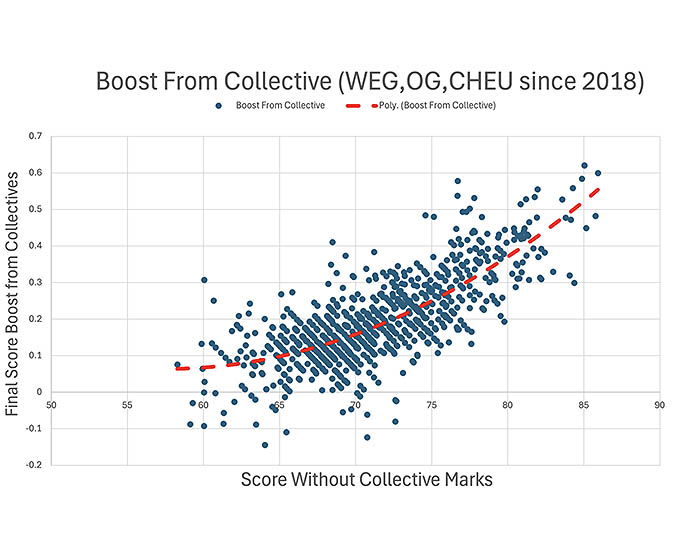
The collective marks do not, in fact, reflect the technical marks. What we see is that the boost a rider receives is almost directly proportional to their technical score.
I don’t mean they get more or less the same in collective than in technical, but the higher your technical score is the more your collectives further boost your final score. The plot shows that this boost, from a single collective mark is 0.5% for the top riders.
Each point in the plot below is one of the 886 results in this study. On the horizontal axis is what the scores would be WITHOUT a collective mark (taking account of its x2 coefficient), and on the vertical axis is the additional percentage points when the actual final score includes the collective marks. The red dashed line illustrates that the higher scoring riders get a proportionally higher boost from the collective marks.
Collective Marks Increase Subjective Judging
The science is well established, the extra task of assigning an overview mark with precision places an excessive cognitive load on the judge and increases subjectivity compared to objectivity.
The data we have analyzed shows that even in our top-level events some 20% of ranks are affected by this extra mark and even in the medal positions ranks are changed by this additional, subjective mark. Perhaps at lower level events these collective marks can be of use to encourage up-and coming athletes and point out that while technically there were mistakes, that underneath there was potential, but it does not make sense at elite level.
Let's End Collective Marks
As Davison points out, “these days the integrity of the dressage sport and its international governing body, the FEI, is constantly under scrutiny. We are not only watched over by the public but also by organisations such as the International Olympic Committee. This is especially so when it comes to producing a level playing field and the provision of fairness. Subjectivity in dressage judging is already a highly sensitive part of our sport, even more so to the larger mainstream audience."
This is our opportunity to be brave and finally remove these subjective marks from the evaluation of top-level dressage and instead focus on ensuring that every individual movement score respects the demonstrations of harmony and wellbeing that we and the international governing bodies of top-level sport correctly demand.
There should be no place for such subjectivity in an Olympic level event and an Olympic sport.
Finally, I present to you a fictional scenario….
What if FIFA proposed the use of “Collective” goals in soccer?
We propose the introduction of collective marks to reward really good goal attempts that were of very high quality but unfortunately failed to go into the goal After the match the referee could assign fractional goals for each of such excellent, but failed, attempts. In addition, the best quality successful goals could also be awarded extra fractional collective goals, and poorer quality “lucky” goals could have some collective goal deductions. The final score would be decided by the addition of actual goals and collective goals.
Probably that would not survive public review and even FIFA might not be brave enough to propose it….