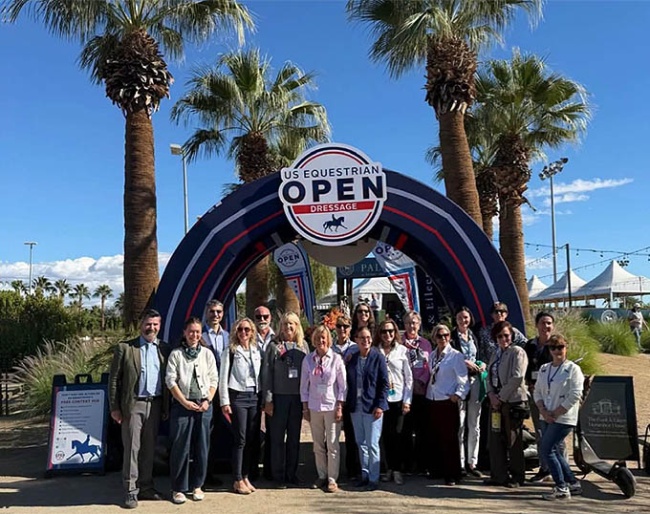
-- Text by Danish 5* judge Hans-Christian Matthiesen, president of the International Dressage Officials Club (IDOC)
Last weekend, alongside the US Open Finals and the CDI 5* in Thermal, California, a dressage judges’ seminar was held. It was organised by the FEI and USEF together, with support from IDOC, The Dressage Foundation and the Michael Poulin Grant.
Participants included national judges and international Level 1, 2, 3 and 4 judges. They came from most of the United States, as well as from Brazil, Mexico, Peru and Australia. It was two days of many lively discussions on the technical side of dressage, and also on the future of the sport and how we can create better conditions for everyone involved.
Discussion Matters
Discussion matters. We do not always have to agree, but it is important to reach some understanding of each other’s points of view. Within your own domain you may be firmly convinced that you are right. Even so, it does no harm to broaden your horizon and try to understand why someone else, even from the same discipline and level, can see a technical question or a particular issue completely differently.
As Course Director, my most important task is to create a forum where there is room for different opinions. I can do a great deal to inform, educate and argue my case. What matters most to me, though, is that the candidates push themselves to analyse a situation and reach their own conclusion, within the framework of the principles of dressage and its rules and guidelines. Transparency and honesty are key ingredients. Here it helps when the Course Director dares to step forward and admit his own mistakes and limitations. We must be able to acknowledge our human weaknesses, such as the various biases we know exist in a judged sport like ours.
Lameness in Dressage Competition
The seminar opened with lameness in dressage competition: how to recognise it and what to look for. Lameness problems are linked to the amount of stress and conflict behaviour a horse shows. We studied many competition videos and discussed how judges should, and can respond.
Stretchy Circle
The FEI will soon launch new dressage tests. We discussed some of the “new” movements, first and foremost “allowing the horse to stretch on a half circle”. The movement is not new. Apart from its place in training, it has already been part of several tests at the lower levels. Now, however, it appears in most tests, including the Grand Prix. We looked at several different examples of how it can be ridden.
As Course Director, I come to a seminar very well prepared. One advantage of coming from Denmark is that we have had the stretching-exercise in our tests for some time now, all the way up to Grand Prix level. So I came ready to show the movement ridden not only by young horses, but also by Grand Prix horses in Grand Prix tests.
The discussion is interesting, as it has been interesting to follow the many opinions about this movement. Usually the debate is not about whether riders use it, since they do. It is more about whether it belongs at, for example, Grand Prix level. I believe it is exactly right, especially now that we want to show that dressage can be about more than collection, expression and the number of piaffe steps! Ideally, a horse should look supple and relaxed in every other movement as well. Still, it is important to dare to “give the reins away” in a completely different element of the test.
Stretching at Grand Prix Level
It turns out, of course, that a stretching exercise looks different on a five-year-old dressage horse than on a more educated 15-year-old Grand Prix horse. There can be many reasons for this. The horse’s conformation can also partly give the movement a different expression. A horse coming from a higher degree of collection may not stretch like a five-year-old, or like a junior horse at medium level working with less collection. Yet the movement can be just as revealing at every level.
As judges, can we expect every horse to perform it the same way, and can it be compared across levels? I do not think so. There are of course minimum requirements that must be met, but we probably cannot expect every Grand Prix horse to stretch like the young horses do. In the coming period, it will be important to establish what we expect: what the minimum is, which criteria must be fulfilled, and which problems should trigger a “firewall” and a low mark.
The Walk
In addition to CES testing of all participants, there were discussions on the walk, and on how different judging positions, seen from different camera angles, can influence the assessment. We went through many different “what to do” situations, and these were debated vigorously.
Refreshingly Honest
All in all, it was a good seminar with a refreshingly honest forum. We did not agree on everything, but we left with a better understanding of each other’s arguments. We also left a little more open to seeing, and perhaps judging, in a different way next time.
Alongside the seminar, we could watch the CDI5* competition live and comment on it. Last but not least, we got a valuable insight into Becky Moody’s training principles. Her MasterClass was a delightful “no nonsense, just back to basics” presentation. It came with charming anecdotes and training principles that were honest and open throughout, always on the terms of the horses shown.
Education matters at every level. In-person meetings, where people can interact live, make a big difference, even though they are demanding and financially difficult to put together. They are an important part of the sport and of securing its future.
- by Hans-Christian Matthiesen
Related Links
How to Apply FEI Judging Guidelines on Tension, Submission, Acceptance of the Contact, and Harmony
Matthiesen's 2025 End-Of-the Year IDOC Message: "On Achieving Lasting Change Through Education, Discussion and Collaboration"
Hans-Christian Matthiesen: "On the Importance of Continuing Education and In-Person Meetings for Officials"
IDOC: "Have the Scores Gone Down? Maybe They Have"