- Text by Sarah Warne-Furtado for Eurodressage
Have you ever watched a young horse which is not straight, or supple, or in good rhythm at a working trot, and then the rider asks for passage? Have you seen a horse that is not balanced or straight in canter being asked for flying changes? Some people want to rush through to present a “trained” horse, while others want a step by step guide as to when to introduce what, and at what age.
To ask for collection a horse must have developed the balance, impulsion, straightness, suppleness, and strength to carry more weight on the hindquarters without tension or loss of rhythm. Most four and five year olds simply don’t have all these necessary things in place, yet we see them being asked for things that require high degrees of collection.
When to Introduce Collection
Nuno Oliveira says collection is when “the horse is so well balanced that the rider can ask any movement already taught with the minimum of effort, obtaining great promptness of execution." How to get there? And when to introduce new exercises?
I talked to classical trainer Anja Beran and asked her about collection in young horses and if there is a guide as to when a rider should introduce certain movements.
“It is not the exercises you ask of a horse that is the problem, or even when you ask, but the way in which you ask," Anja replies. “The five year olds you see doing high school exercises are not collected, they are simply pressed between hand and leg and show tense movements!” Anja advises that it is the horse who commands when you advance in training. “We can never say a horse should stay until (insert age here) on a basic level!”
When we refer to basic training, Anja says we are talking about transitions, bending and straightness, and adds that “the only way to straighten a horse is to use the gymnastic benefits of lateral movements. Lateral movements lead automatically to collection!” Anja says. “Through correct use of lateral movements, horses start to put more weight to the hindquarters, the back begins to work, the forehand gets lighter because horses start to bend the big joints of their hindlegs.
Piaffing at Age Five
There are young horses at age five that you can start some piaffe steps on, but the idea in classical training is never to produce a piaffe immediately to present it as soon as possible in a grand prix test. The idea is to train the piaffe little by little and to use this exercise to give more strength to the horse’s body, especially his back and hindquarters.
Piaffe is a natural movement and we use it to help the horse, not to put the horse under pressure and maybe even destroy him. We see this at every level of training. Riders will say, “I am working on the shoulder-in” and they are thinking about executing a good shoulder-in. Whereas a classical approach would be “I am feeling this, so I will use the shoulder-in to…” It may seem subtle, but this small change completely alters the way you think about the gymnastic training of the horse.
The Aspirin of Equitation
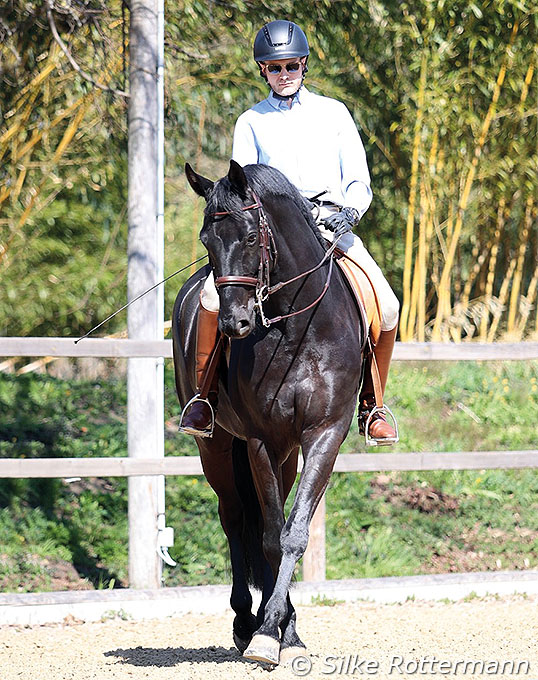
by switching from one different lateral
movement to another, the rider effectively learns
to control the horse’s shoulder
Anja also stresses the importance of training the horse from the back to the front. “Without any auxiliary reins, the piaffe (just an example) out of collected walk or rein back (from back to front without tension) and not from trot pulling backwards into steps on place (from front to back) or with a system of auxiliary reins and lunges around the legs to get artificial movements,” says Anja.
Pushing Too Quickly
I asked Anja what the signs are that a horse has been pushed too quickly. “Riders have no idea nowadays of true collection and the proof is that 99% cannot do collected walk. So that tells us everything and is one sign of incorrect training methods because no work in the walk has been done. Other signs include that the horses are loud when they move, so they step hard on the ground and breathe loudly! They make noise with the teeth, have tongue problems, have tight nosebands, have broken diagonals in trot, have a four beat in normal canter, are behind the vertical, poll is never highest point, neck much too short.”
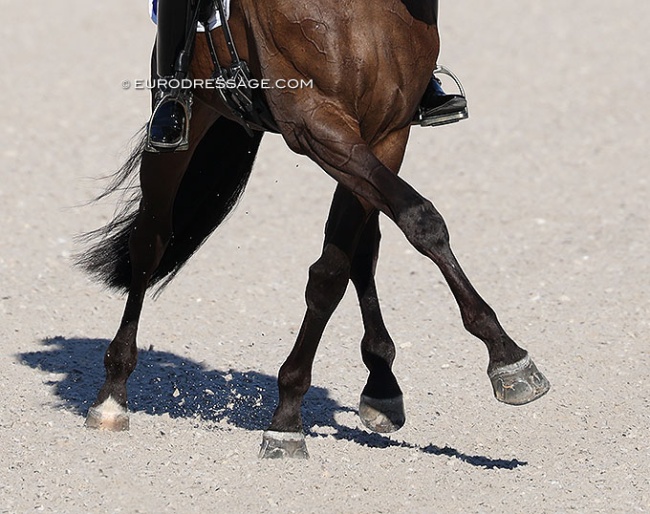
Anja discussed a feature she believes is often seen in top-level competition: a passage in which the front legs appear to hang and fall backwards with each step. “This is because the hindlegs make an artificial stop in the air, instead of going up, forward and down!”
Anja stresses that this is unnatural and not the result of true collection and training. “The horses who do passage in this way also never open really the frame, they do passage and extended trot with the same neck! You also can see a hollow back in most of them!”
This is also the reason why we see the half pass being done in extended trot. “The normal trot that the dressage horses show is not natural after a while – it is a trot with an artificial moment of suspension, with a slow hindleg. It looks impressive like dancing, but it’s not natural and the back is not involved, that’s why they have to do half pass not in collected trot, but in trot in extension.”
Again this is highly subjective to every horse, but as a rough idea, Anja advises:
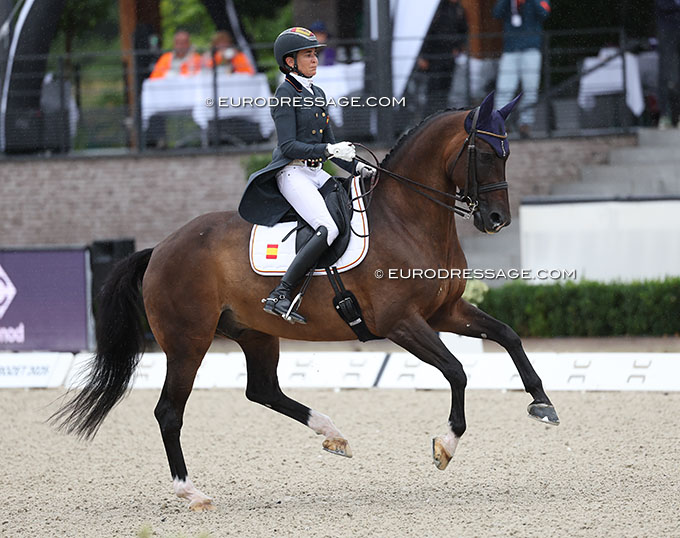
“Flying changes we only start when the horse is a 100 % sure in counter canter. Counter canter on circles also and on small voltes!”
Half Pass
“Half pass we start already when they are 4 years old but only short distances and always in walk, often in hand. They learn to use their bodies with very light reins, listen to the rider’s seat and fine leg aids, start to chew on the bit and find their natural balance. Later we can take all this balance and lightness into trot without any muscle power of the rider! Everything is done in short sequences with lots of breaks on a long rein, where the horse can stretch his neck completely and relax. So little by little the horse gets super attentive and fine!”
Standing Closed and Still
"The horse should stand closed and still after piaffe” “Do everything step by step – the brain of a talented body also needs time to develop! “Don’t go over the capacity of such a horse! As these horses offer sometimes more they can give – don’t push them. Wait for them instead!”
Gymnastic Foundation
In this sense, collection is not a separate phase of training but something that develops progressively through correctly applied gymnastic exercises.
“The horse will show you balance, engagement and self-carriage when the gymnastic foundation has been accomplished, but of course this takes years," says Beran.
“Dressage is only gymnastics for the horse and the rider is the physiotherapist for his horse," as Gustav Steinbrecht stated. "All [training exercises] follow one another in such a way that the preceding exercise always constitutes a secure basis for the next one. Violations of this rule will always exert payment later on; not only by a triple loss of time but very frequently by resistances, which for a long time if not forever interfere with the relationship between horse and rider."
I remember many conversations with the classical masters in Portugal and upon asking them about riders who were doing pirouettes and passage on five year olds, they would reply something along the lines of “those riders are trying to reinvent the wheel."
In Pursuit of Connection and Understanding
Classical training in the correct way is the pursuit of connection and understanding. It therefore requires great patience and tact on the part of the rider.
Nuno Oliveira said, “I bow to the rider who, indifferent to his surroundings, works the horse to his own satisfaction, and having tried to attain his ideal, terminates the lesson, dismounting from his horse content and yet, at the same time, dissatisfied. Content because the work went well, dissatisfied because he feels his achievement to be far from the ideal.”
Classical horsemanship is a patient gymnastic progression in which each exercise prepares the horse for the next, and the horse himself determines the pace. “Never ask for more than he is capable of giving," Oliveira stated.
Photos © Astrid Appels - Silke Rottermann