-- Aachen 2026 press release
On Wednesday 19 August 2026 the para dressage competitions at the World Championships in Aachen will begin – a discipline that demands the utmost precision, empathy and clear structures, from both the horse and rider.
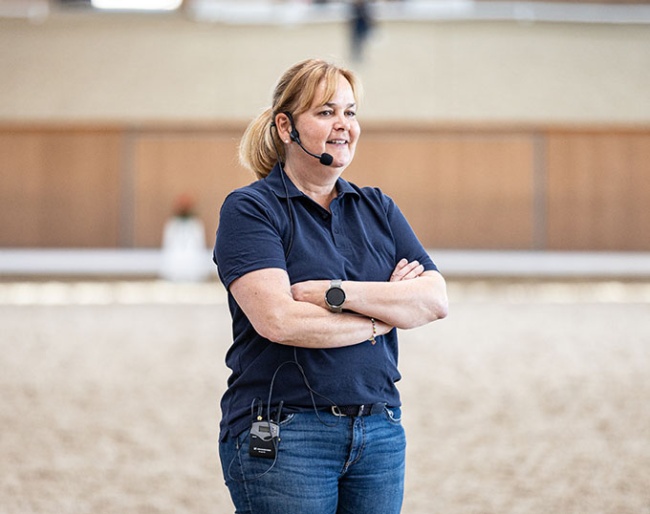
In this interview, the German national coach, Silke Fütterer-Sommer, explains how the classification into grades works, the role of aids and why para dressage stands on an equal sporting footing with ablebodied dressage.
How are the individual grades defined and what is the basis for this classification?
The five grades reflect the severity of the riders' disabilities – ranging from the most significant impairments in Grade I to the least severe in Grade V. The demands and the complexity of the dressage exercises increase accordingly. In Grade I, riders exclusively perform in walk inside a 20 x 40-metre arena. The focus is on precise lines and a completely steady, consistent rhythm. In Grade II, the size of the arena is the same, but brief sequences of trot are introduced. Movements such as lateral work and leg-yielding are additionally required at the walk. Grade III tests are also performed in a 20 x 40-metre ring, featuring walk and trot work with significantly longer trot phases, transitions, serpentines and leg-yielding at the trot; the demands regarding precision, balance and responsiveness increase noticeably here. From Grade IV onwards, the competitions are held in a 20 x 60-metre arena. The standard roughly corresponds to an L**-level test in able-bodied dressage: Walk, trot, canter, lateral work, shoulder-in and extensions in trot and canter all form part of the standard exercises. In Grade V, where riders with the least severe disabilities compete, the tests are based on the M** level. Half-passes in trot and canter, a variety of lateral movements and simple flying-changes require an extremely high level of training for both the horse and rider.
What are some specific examples of the disabilities found in the various grades?
Athletes with advanced multiple sclerosis, for example, compete in Grade I. Many of the participants have severe motor impairments and have very limited – or no – controlled movement of their arms and legs. Grade III includes riders, who suffer from severe impairment or even the absence of two limbs. These riders are often dependent on a wheelchair in their daily lives.
What criteria determine the grade in which a rider competes?
Before commencing with the sport, para equestrian riders take part in an official classification process. This involves completing various tests and movement exercises. Based on the results, specialised medical professionals and physiotherapists assign the rider to the appropriate grade. This ensures that athletes compete against each other fairly and corresponding to their specific disabilities.
In para dressage, the use of aids is permitted…
…yes, exactly. So-called compensating aids are implemented, which are individually adapted to the specific grade and the rider's needs. For instance, riders in Grade II with complete paraplegia, who cannot move their legs, are permitted to use special stirrups that secure the toe to provide extra support and stability. Velcro straps over the thighs are also commonly used in para sports to help stabilise the rider’s seat in the saddle. The decisive factor here is on the one hand that these aids provide sufficient support, but at the same time they must release immediately and effortlessly in the event of a fall.
What are the differences to mainstream equestrian sport?
At a glance, there are fewer differences than one might expect. The horses are trained according to the same training scale that is used for mainstream sport: The aim is to have sensitive horses that are responsive to the aids, willing to cooperate and highly supple. The key difference lies in the training of the athletes themselves – and this is a highly individual process. For instance, if riders cannot use their legs, but nevertheless want to perform a lateral movement at the walk, I – as the trainer – must find an alternative way to explain the sideways movement to the horse without using the classic leg aid. In such cases, compensating aids come into play; for example, the rider might use two dressage whips against the horse's sides to replace the missing leg aid. This ensures the riding style remains correct according to dressage principles, even if the way the aids are applied appears to be different.
Are there any special rules regarding the competition procedure?
Yes, special rules apply for the preparation of the horse, particularly in Grades I, II and III. In these grades, professional riders or trainers are permitted to warm the horses up for a maximum of 30 minutes. This time is measured precisely by the stewards. The reason for this is that some athletes, due to their impairments, are only able to work the horse in walk. At the same time, we place great importance on ensuring that the horses are exercised sufficiently to ensure suppleness and are able to move in all basic gaits so that they remain healthy and fit for performance. During these 30 minutes, the horses are therefore ridden conscientiously, working through trot and canter to loosen and warm them up, before the athletes mount themselves. This rule applies exclusively for Grades I through to III. In Grades IV and V, the riders are responsible for warming their horses up themselves.
Related Link
Eurodressage Coverage of the 2026 World Championships Dressage