There is a moment every rider knows. The lesson ends, the coach walks away, and by the time you untack your horse, the clarity of that session begins to dissolve. The correction that finally made the half-pass click, the imagery your trainer used to unlock that elusive connection, the three things you promised yourself you would focus on next time. Gone. A forgotten lesson is a repeated mistake.
For decades, sport has followed the same model: lessons happen in real time, then riders practice alone with no oversight. Coaches are left guessing what happens in between - whether progress continues or quietly unravels. It is a system built on trust and memory, two things that are, by their very nature, imperfect.
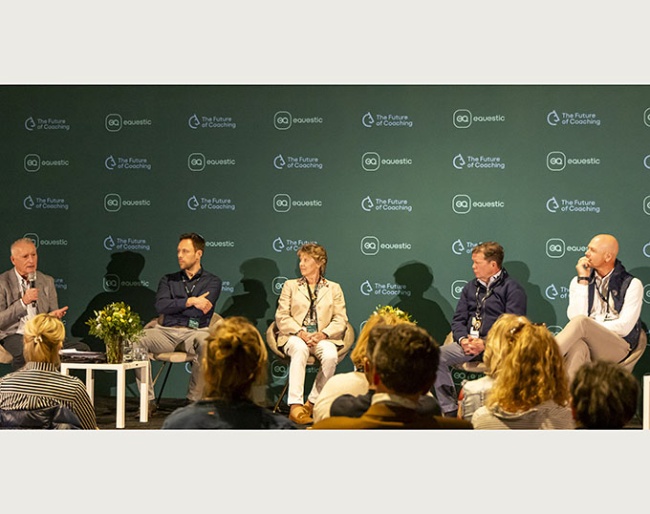
This was just one point of discussion at the Future of Coaching forum, an innovative panel discussion created in partnership between Equestic, an equestrian technology company, and The Dutch Masters, one of the prestigious show’s history.
The panelists and 100+ audience consisted of some of the most recognized names and faces in the industry, all of whom felt it was important to be part of this relevant topic of conversation.
Moderated by Richard Davison, a four-time British Olympian and European medalist, panelists included Di Lampard MBE, Laurens van Lieren, Wout-Jan van der Schans, François Mathy Jr, and Leon Rutten, Founder and CEO of Equestic.
The speakers offered a spectrum of perspectives on the role of adding technology in modern coaching while retaining true horsemanship.
Smart Assistant for the Modern Coach
The space between lessons is exactly why Equestic has launched its new product, EQ Coach-Copilot.
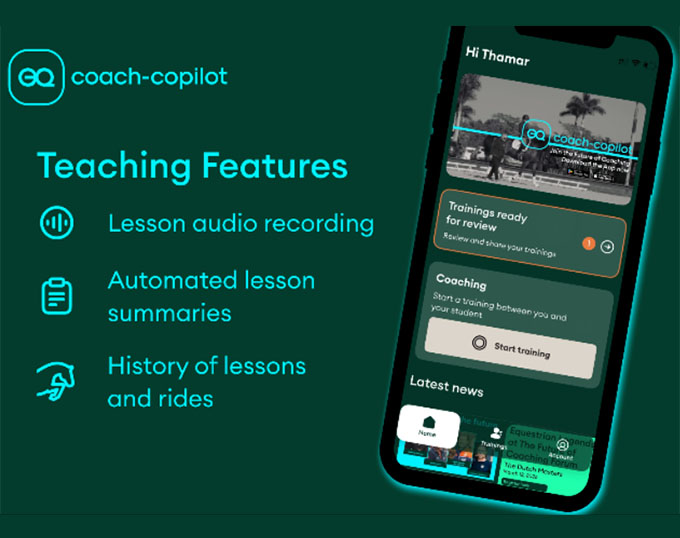
For coaches managing multiple students across multiple levels, this kind of structured continuity is the difference between teaching that compounds and teaching that resets with every session.
The Problem That Everyone Knows but Few Discuss
Ask any dressage coach what their biggest frustration is, and somewhere near the top of the list will be a version of the same answer: coaches who consistently have to repeat themselves and, riders who arrive at the next lesson having undone what was built in the last session. Not through laziness, but through the fog of forgetting, the distortion of memory, or the absence of any objective reference point.
These are structural problems, baked into the traditional model of equestrian education. No amount of dedication on the part of rider or coach fully compensates for the simple fact that human memory is unreliable, and that horses cannot tell their owners when something isn't right.
Lendon Gray, Dressage Olympian, 2024 US Equestrian Lifetime Achievement Award recipient, and founder of Dressage4Kids has spent a career watching this dynamic play out. Her perspective on what EQ Coach-Copilot means for the homework problem is characteristically direct.
"I think the homework aspect is something a lot of us, as instructors, don't pay enough attention to. When I get to the end of a lesson, I have my students give their horse a walk instead of stopping them and saying, now remember this and this. As teachers, we should be doing that and having EQ Coach-Copilot do it for you is even better. If you're not keeping some sort of record of your lessons, you're not giving yourself every opportunity to become the best rider you can become."
That last sentence deserves to sit with coaches for a moment. Not keeping a record of lessons is, by Gray's measure, leaving opportunity on the table for the rider, and implicitly, for the coach whose teaching does not survive the arena gate.
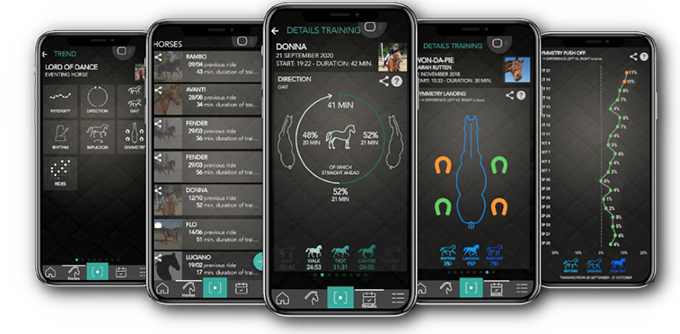
EQ Saddle-Clip App
What Riders Actually Experience
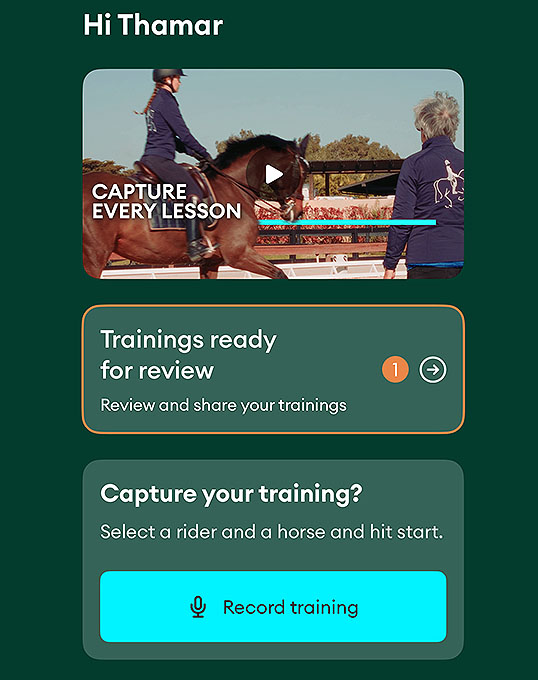
While EQ Coach-Copilot is built foremost as a professional tool for coaches, its impact lands most tangibly with the rider. Between lessons, which, for most amateur riders, means several days in the saddle without any expert present, the app becomes a training assistant. The rider hears their coach's priorities, rephrased and structured into actionable guidance. As the product develops, riders will be able to record questions in the moment, capturing thoughts that would otherwise evaporate by the time the next lesson arrives, and their progress will be automatically reported back to the coach ahead of the following session.
"Riding is such a difficult sport because what other sport is there that you can only practice for like 45 minutes a day? But if you only have one horse, you have to make that 45 minutes really, really count," Lendon Gray stated.
Meanwhile, EQ Coach-Copilot does not replace the coach. What it does is make the coach's presence feel across every ride, not just the ones they can physically attend. By combining the coach’s expertise with objective data from the EQ Saddle-Clip, an advanced equine performance monitoring device designed to provide objective insights into horse’s quality of movement and workload structure, EQ Coach-Copilot accelerates the rider’s ability for deep learning.
Coaches Who Have Already Experienced Its Value
The credibility of any new technology in equestrian sport is built through the voices of those who have tested it.
Laurens van Lieren, Dutch World and European Championship medalist and current KNHS Technical Manager, was among the first professionals to evaluate the platform. His assessment focused on something practical: the speed and quality of the AI summary.
World Champion FEI Trainer Nuno Avelar, who works with riders and horses across multiple countries, pointed to the cognitive reality of coaching at the highest level: "No one can remember 100% of every word after a lesson. That's where EQ Coach-Copilot helps on this matter."
Dutch rider Tessa Kole, one of the promising young talents in Dutch dressage, won the National Dressage Z2 Freestyle class at The Dutch Masters 2026, achieving 77.833% with her mare Odi Murona. Trained by Dutch team rider and coach Thamar Zweistra, the pair delivered the strongest performance of the class in Arena 2, finishing ahead of a competitive field and confirming Kole’s rising profile in the sport.
“In our training we used the EQ Saddle-Clip and the Coach-Copilot app, which allow us to measure exactly how the horse moves and review each training session in detail,” said Dutch team rider and coach Thamar Zweistra, who works with Kole. “The Saddle-Clip is really useful for the welfare of the horse, because it allows us to see the horse’s diagonal movements and how evenly it pushes left and right. This helps us understand whether the horse is moving in balance on both sides and adjust the training accordingly, so we support performance while protecting the horse’s physical well-being.”
“It’s amazing how many details you can see from the training,” said Tessa Kole. “With the Coach-Copilot app I can review my training afterwards and continue practising the exercises at home by myself. It really works for me because I can review my training better and train more effectively. Thamar can also review the session, so we both clearly see what we did in the lesson and how the horse moved. In the end, I think that helps us progress better.”
New Kind of Coaching Relationship
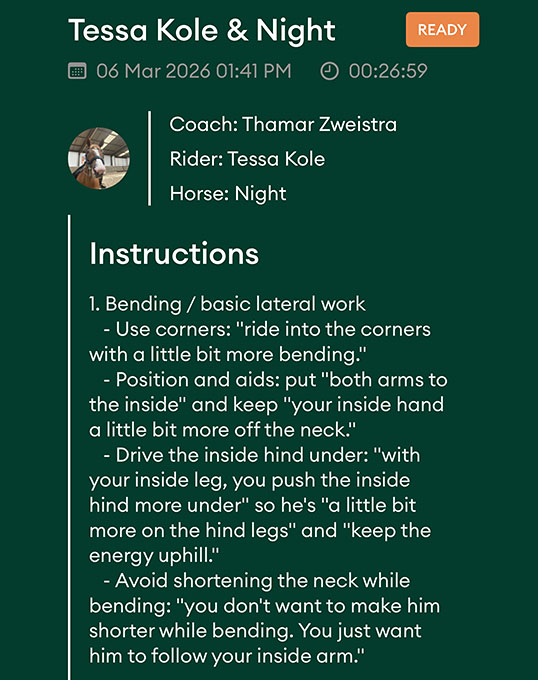
and visible on your phone
For a sport where elite riders have long understood the value of marginal gains, and where amateurs are often working with limited lesson time and limited budgets, this kind of continuity has real consequences. It means that a rider who trains once a week with a coach, and the rest of the week on their own, can now in a meaningful sense, train with their coach every day. Lessons are an investment, and now riders can make the most of them.
That is a fundamentally different model of equestrian education, and it arrives not as a replacement for the tradition that built this sport, but as the most useful tool that can enhance the profession.
EQ Coach-Copilot is available worldwide, free to download, on the Apple App Store and Google Play.