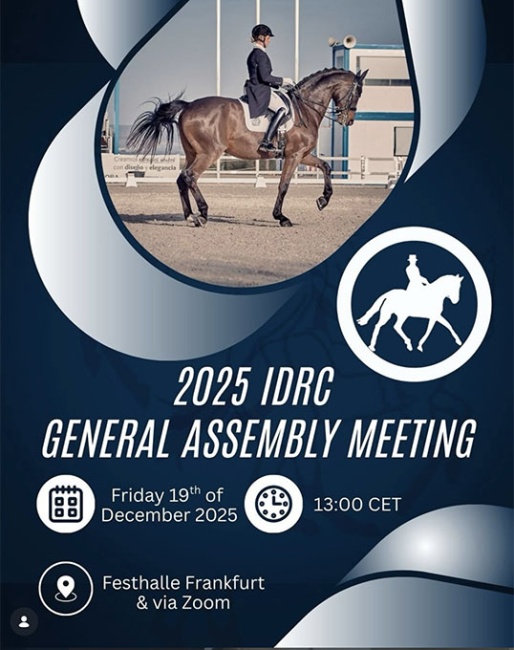
The International Dressage Riders Club (IDRC) held its annual General Assembly during the CDI Frankfurt on Friday 19 December 2025. The GA was held in-person and via Zoom with a total of 17 participants attending, of whom 11 were members entitled to vote.
Amongst the topics of discussion were the noseband measuring, blood rule, double bridle and the publication of the judges' commentary.
Read carefully is it is very interesting to see where the "riders" stand on certain topics, which differs from the judges, trainers, and what the FEI and/or press believes is the way forward for the sport.
The IDRC is headed by Germans Isabell Werth (president), Klaus Roeser (secretary-general), and Michael Klimke (treasurer), and has Kyra Kyrklund as vice-president. Other board members are Carl Hester, Yvonne Losos de Muniz, Hans Peter Minderhoud, Victoria Max-theuyrer, and Catherine Haddad according to the IDRC website.
The IDRC discussed the following:
Noseband Measuring
- Ongoing discussions with the FEI regarding the introduction of the measuring device
- Evaluation of the impact on horse welfare and judging
- Topic addressed at the FEI Level 4/5 Judges Seminar, particularly regarding the consequences of open mouths under the new measuring system
Snaffle versus Double Bridle
- Continued discussions with the FEI on the mandatory use of the double bridle at top level sport
- Consultations with specialized experts
Use of Artificial Intelligence
- Numerous meetings with the FEI, judges, and IT companies
- Exploration of potential applications of artificial intelligence, including:
- More objective assessments
- Analytical support for judges’ comments
- Further digital development of dressage sport
Internal Discussion and Voting–Revision of the FEI Dressage Rules 2026
An in-depth internal discussion took place on the key topics of the upcoming FEI Dressage Rules revision 2026:
- Adjustment of the Blood Rule
Adjustment of the Blood Rule
The participants agreed in principle that a uniform Blood Rule should apply across all FEI disciplines. With specific regard to dressage, the following approach was supported for future regulations:
· If blood is detected on the horse within the rider’s area of influence, this should result in automatic elimination.
· If blood is detected outside the rider’s area of influence, this should not lead to automatic elimination; instead, the horse must be examined immediately by a veterinarian.
- Snaffle / Double Bridle at top-level sport
There was agreement that the double bridle should remain mandatory in 4 and 5 competitions**. It was noted that the outcomes of the current FEI test phase must be awaited in order to obtain meaningful and evidence-based results.
In this context, the question was also discussed as to whether the FEI has conducted a study examining a potential increase in mouth injuries since the introduction of the noseband measuring device. If no such study exists, it was agreed that the FEI should carry out an appropriate scientific study.
- Publication of judges’ comments
A majority of participants spoke out against the publication of judges’ comments. It was emphasized that judges’ comments are intended for the riders, who ultimately also indirectly pay for this service.
It was further noted that there is neither a legal basis nor a uniform consensus requiring the publication of judges’ final scores or detailed comments. Both the FEI Dressage Rules and, at national level, the regulations of the FN, clearly state that judges’ comments are intended to explain and justify the awarded (and published) marks, primarily for the benefit of the riders.
Against this background, it was acknowledged that a certain degree of transparency through the publication of marks is already ensured and that any further publication of comments would, in practice, follow automatically from this principle. The arguments put forward in favor of withholding judges’ comments were therefore critically reviewed, as they risk appearing to be based more on personal considerations than on a solid legal or regulatory foundation, which may ultimately weaken the credibility of the position vis-à-vis the FEI.
Also in light of these arguments, the publication was viewed critically by a considerable number of participants.
Through the publication of marks alone, the general public is already sufficiently informed.
If publication of judges’ comments were to be considered at all, it could only take place with the explicit consent of each individual rider.
- Use of artificial intelligence
There was unanimous agreement that the FEI must continue to work on this topic with high priority and urgency. It was emphasized that it is essential to obtain timely, reliable insights into what is technically feasible, to what extent, and with what level of reliability. Only once this factual and technical basis is established should a substantive discussion take place on how and in what form artificial intelligence could be integrated into the judging and evaluation process.
- Introduction of a transparency register for judges
There was unanimous agreement that such a transparency register, which has already been repeatedly urged in discussions with the FEI, must be introduced without delay. It was further agreed that this measure should also be implemented at national level, and members were encouraged to address this topic with their respective national federations. It was noted that Germany has already decided to implement such an approach.
- Collective marks
There was unanimous agreement on the desire to introduce two separate collective marks, one specifically for the horse and one specifically for the rider, to allow for a clearer and more differentiated evaluation.
(editor's note: the IDRC has been pushing for this for years, even though scientific evidence proved that more collective marks makes the judges more subjective as the judges have misused the collectives in the past to push the score of a certain rider up or down.)
- Grand Prix starting order (ordinary draw)
It was agreed that the FEI should actively work towards ensuring that the ordinary draw is more consistently implemented by event organizers. In this context, it was discussed whether it would be sensible to make the Olympic format for determining the starting order mandatory for other championships as well, as this format has proven to be highly effective and fair.