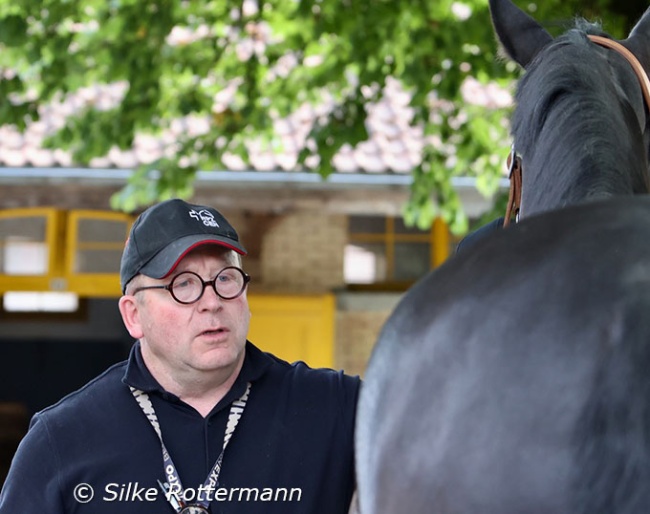
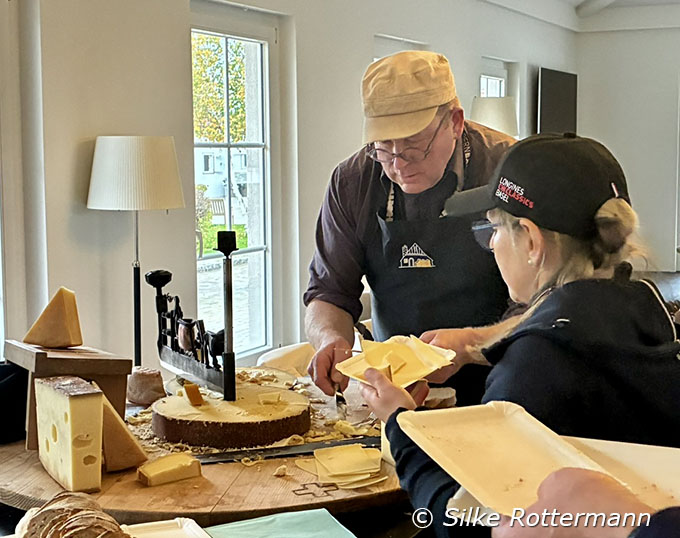
On his home turf in Switzerland Dr. Beat Wampfler is. called „an original“. Head of the equine clinic of the National Horse Centre (NPZ) in Berne as well as a renowned equine chiropractor he became known to a wide audience in his country as za cheesemaker because his cheese is piped with music during the ripening process.
In June this busy, jack of all trades took the time to give Eurodressage an interview on topics which equestrian sport has to deal with for years. He not only took a firm stand on how to handle growing criticism from equine welfare activists, but also spoke out in favour of a readjustment of judging and dressage horse breeding.
Eurodressage (ED): Dr. Wampfler, you’re an equine vet and also busy treating sport horses as an experienced chiropractor. Can you outline your philosophy for us?
Dr. Beat Wampfler (BW): For me the relevant topics are the conformation of a horse, classical training, chiropractic and veterinary science which all go together more or less.
The first time that I occupied myself more with the topic of conformation was when I read the legendary book „Pferdekenner und Fehlergucker: Kriterien für die zeitgemäße Beurteilung des Pferdes“ by renowned German hippoplogist Hans-Joachim Köhler (1917-1997) and also the books by Dr. Gustav Rau (1880-1954) about breeding. They were written in a time when breeding was different from nowadays and Olympic champions were not perfect in their conformation. However, we have to be aware that our modern sport horses have their own conformation related problems we have to deal with.
Then classical dressage, a term which is often used. We have to make ourselves aware what happens when a horse is classically trained. The most simple example is the comparison to a pendulum clock. The weight of such a clock goes back and forth, it has self-oscillation. Because of that a pendulum clock might last 100 years or longer with no problem. If we have a clock which has a small inbuilt hammer which hits an anvil every 15 minutes, it seems obvious to us that it might be broken much earlier than the clock with self-oscillation.
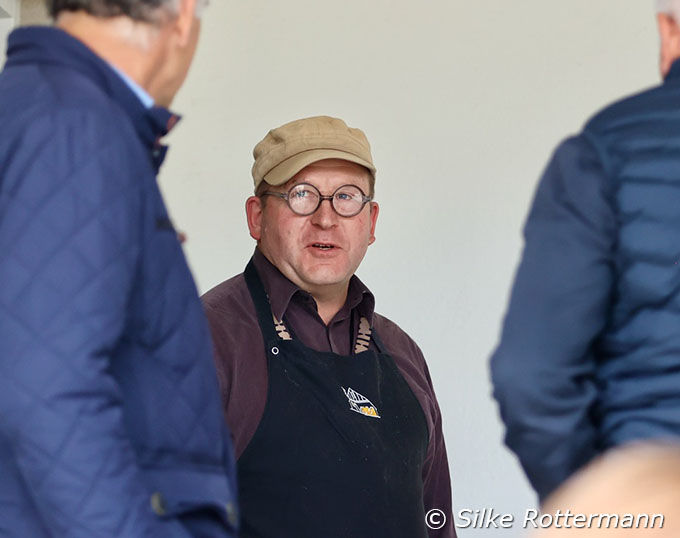
If I have a horse, which is not under negative tension, I have this sinus wave from the tail over the back to the poll which is the natural swing and the legs keep up longer. And now comes the chiropractic, which primarily works with the spine. As soon as a horse has blockages we do not have self-oscillation anymore, but the hammer. The knee gets stretched and the movement entirely affects the fetlocks which then go down. That is the reason I do not treat fetlocks anymore, because the original problem comes from the spine, the saddle, or the riding, or has its origin in the genetics of some horses.
ED: This is where I see the problem: on the one side a fading knowledge about how to train a horse correctly and on the other side the breeding which sometimes seem to have gone too far.
BW: If judges reward tense movements with swooshing tails, but incredible impulsion with a 10,5 while something harmonious and relaxed, but with more modest movements gets punished it is obvious that neither breeders nor riders, nobody, gets the chance to change anything in this current system.
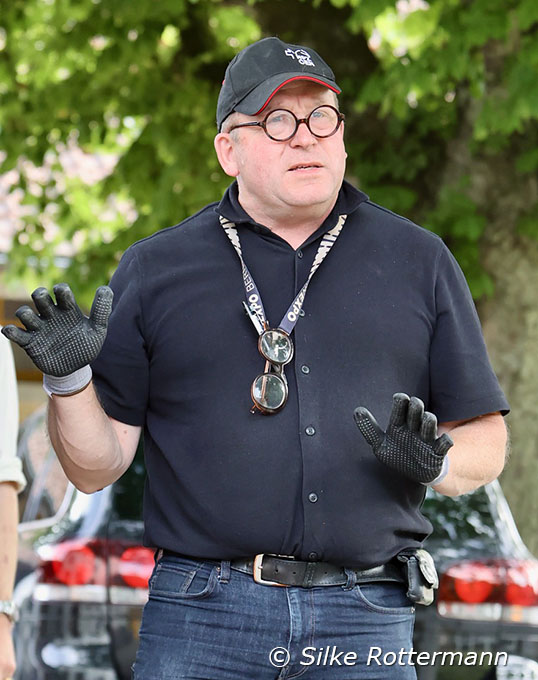
We have about 90% of pleasure riders, people who want to have fun with their horses and who do not ride at top level. And for them we would need to have a different breeding. Instead we breed 90% of the horses with as much movements as possible. Some of them can also be ridden by amateurs, but the others are too complicated.
This is not only a problem with warmbloods, but more or less with most of the breeds. Take Icelandics. I’ve seen Icelandic ponies who are 150 cm, who are hyper fast and are dealt for a lot of money. They’re machines and far away from the cute compact pleasure horses of 135 cm with an easy going character which can be hacked everywhere and are the ideal pleasure horses.
ED: The longevity of modern sport horses is often questioned, while I see several old horses in top shape, over all in eventing.
BW: Dressage is considered the basic, also for jumpers, but if you look at statistics nowadays, dressage horses retire about one year before jumping horses. For me this is a complete confession of failure. Jumping with its landing and turning is considered wear and tear work and still these horses keep averagely longer than those of the discipline which aim is considered to maintain the horse’s health.
The eventers are probably those horses who keep the longest or those of the vaulters.
On this occasion I also want to mention the often criticized polo sport. An outsider might think it is horrible: Those sprints, stops and turns, but the horses I have seen myself in polo clubs lead a good life. They were in the field in groups, they had a good social life. Of course at a certain age fetlock problems are also an issue, but the legs are shorter and sturdier. And when they retired the majority of them could be used as school or pleasure horses for another ten years.
ED: Personally I love to attend competition horse inspections because there you can get a good view of the legs and musculature of the horses. What is striking to me is the sometimes poor musculature of the top line of some top level horses. Is there a relation for you as a vet between this fact and the way of training and riding or even the equipment, like some very centered modern dressage saddles?
BW: 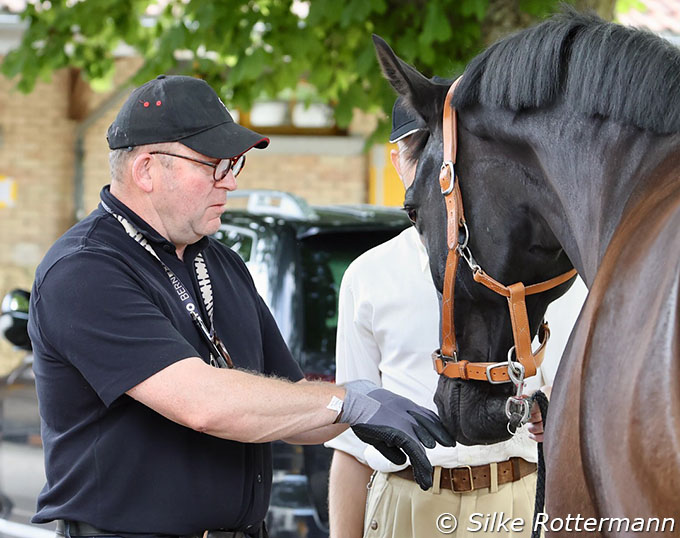
For example there are horses who have these infamous holes behind the withers as a foal, as a young horse and later.
I think the breeding is the main problem here. If you breed a horse in balance it is built compactly: It is not too long, not croup high and the nose is in front of the vertical. You would mean the ideal horse to ride dressage, but even if it can execute the whole Grand Prix, you won’t get anywhere with it. This type of horse lacks the impulsion and the ground-covering movements so essential for becoming successful today.
So the modern dressage horse needs to be long with very long legs. In my humble opinion this is the main problem. Because I am not convinced top dressage horses have ill-fitting saddles and I do not suppose the best riders do not want to work their horses over the back. However, if horses are so long and have so much impulsion, how should this work? They would need to carry the trunk, the withers, the rider and the long neck which ideally then would drop. It is not possible in the same way a more compact horse would handle it. For me these "geometric circumstances," the modern conformation, is almost the origin of the problem.
ED: If you treat dressage horses as a vet and chiropractor, what are the most common problems?
BW: In first place muscular problems. It is a bit like that : the more horses get collected, the more tension in the body. If you ask a horse to go elevated, but the relaxation and the basics to carry himself are not really there, tension creeps in. I am not sure regarding top riders, but in general we do not spend enough time with our horses. It begins in the stable: We have horse-walkers, vibration plates and the likes to exercise horses, but it is unemotional.
Horses are top athletes and they need tender loving care. It begins with good grooming and they need to be exercised seriously 90 minutes at least and in multiple ways. Some riders care a lot about that and go to great length to do their horses justice, others think 30 minutes are enough.
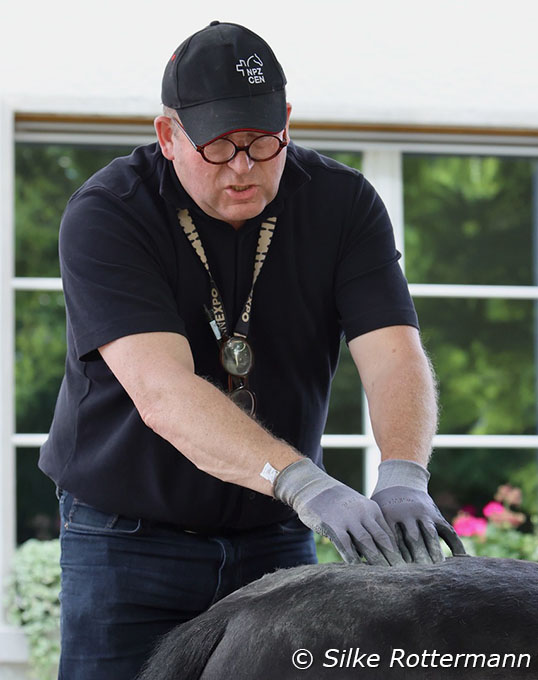
In general the vet is the onlooker and has an important role. I myself see the role of my profession in rehabilitation and chiropractic. Joint injections can help getting a horse back on track, but they are not a game changer when a horse has chronic leg trouble and you do not inject cortisone anymore. Because in a very short term it might help, in long term, one year, it just destroys the cartilage.
Instead good hand work is beneficial because it animates the horse to step under and loosen the sacrum. That way I had quite some success, even with horses who had inflamed suspensory ligaments on both sides. Then they got carefully trained in dressage and then they got stability and the suspensory ligament was relieved.
ED: The sport is more than ever in the crossfire. Spur holes or even oedema are one of the returning topics on social media. Do you think for the sake of the horses’ welfare and the weakened public image horses with such 'injuries' should be eliminated at the vet check?
BW: First of all I want to say: Knowing the conditions of the past, I think that today officials look closer than ever before because everything gets filmed and photographed.
You do not want to know how horses have been worked in the past. Perhaps it also has improved thanks to the horse types which are more light footed and sensitive than many of the past. In the past one had ‚cold‘ horses and if you wanted to make them move, they often got ‚gagged‘ or trainers took the stick - it was not nice to watch. So generally spoken I would carefully claim that conditions might have improved in comparison to the past.
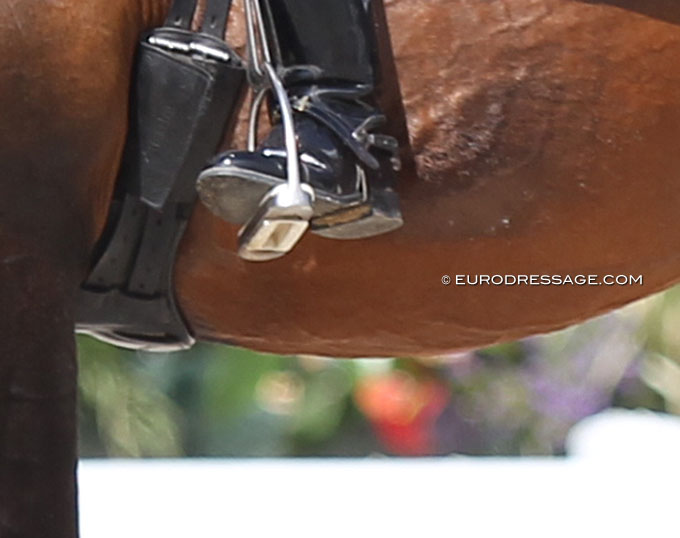
I personally think a vet also needs to take the overall picture into account if we declare a horse ‚fit to compete‘. If a horse looks and moves well, he looks happy and his eyes are bright, he’s fit to compete. Of course it is sometimes difficult to find the golden mean and some things always remain a judgment call.
ED: Equestrian sport has repeatedly produced ugly pictures which brought animal welfare activists on the scene in the more sensitive public perception of today. Their pressure is growing. Is it justified and are enough measures taken?
BW: We all have to do our homework, there is no doubt about that. And there are things which are unacceptable, but we have to be careful not to yield just to satisfy those who complain; many of them have no clue.
We live in a democracy and when the majority says we want to have dressage and 5% question the discipline this no reason. Otherwise we would have an oligarchy: Few demand others what to do. If we always yield as a kind of defensive mechanism we end with a breach in a dyke, then riding as such gets questioned, something we already hear now and then. We have riders who still haven’t understood what is at stake, that we are in the public eye and that the sport gets discussed. If we want to bring justified arguments in favour of the sport, we also have to act accordingly.
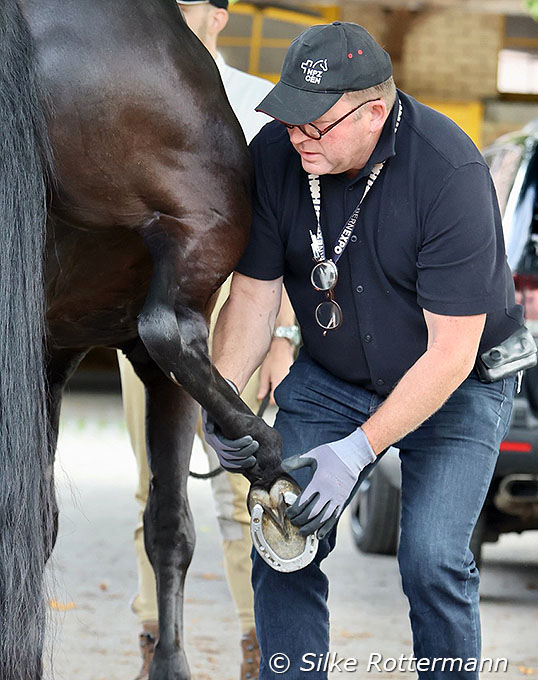
The big abuse to me is not working a horse enough. There are more horses who die of laminitis than of damages sustained in sport. Of course if a horse gets injured in a big competition this goes viral, but it is an exception compared to the ten thousand of cases of laminitis. No doubt, the horse as an animal is innocent and gets used for sports, so the ethical bar should be high, but certainly not only in top sport, but everywhere.
If I were to invent an animal protection law and had only one sentence to do it, I would say "Every horse needs to have the right to be cantered outside three times a week." It sounds simple, but it would mean the horse then would be allowed to stretch and move properly instead of moving back and forth in a small paddock or only seeing a dressage arena. It would change a lot. It would also mean that a tiny pony needs to get properly exercised, in front of a carriage whatever. So there are many problems to be solved and not only in top sport.
SR: The homework dressage sport has to do for the future?
The main problem I see is what we consider a good happy dressage competition. Because the top riders are all very ambitious people and they orientate themselves at towards winning. This is natural. And if these huge ground covering movements are still an essential to win and be successful, this is something I would seriously think about.
In this sense I would begin with the judging. This cannot happen in an instant, but if I could adjust the screws I would lessen the meaning of the ground cover and gaits. I would focus more on suppleness and the transitions instead of excessive movements.
We have to be aware that those spectacular horses yank up their legs. These are movements which are made possible by a hard trunk. They are leg movers. That way the suppleness, the oscillation we talked about at the beginning and the beauty get lost. The readjustment of the judging focus is an easy approach as such, but hard to put into practice for the reasons we all know.
It would also be an important step to readjust the breeding goal we have at the moment: Long horses with an expressive neck which should somehow get short for high level dressage and should carry themselves, but this is pretty hard if not impossible like that. I cartoon and exaggerate a bit, but if these horses push away their backs and curl in they become 5 centimeters shorter and show something similar to collection, but the next what happens is an inflammation of the suspensory ligament. In the end: You can train however you like, but you ride against this horse type. I almost think that even good classical dressage training does not necessarily protect such horses against the results of their conformation.
I am personally convinced riders would also be happy about a readjustment of a too far gone breeding goal because it produces frustration non-end if you invest so much time and effort in a horse’s training and then it becomes a bit irregular and finally he is lame.
So for me the solution is: The judges say what gets rewarded, the breeders deliver the horses which are needed and riders train a horse meticulously and carefully over several years to Grand Prix, like it had already been in the past. A readjustment of the judging is the first step, that of the breeding is then going to follow.
-- Silke Rottermann interviewed Dr. Beat Wampfler for Eurodressage in Berne on 6 June 2026.