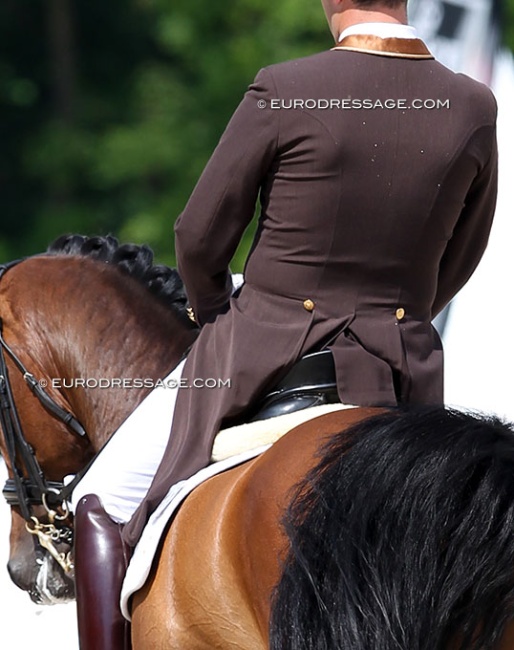
Dressage riders spend countless hours analysing their horse's movement patterns, symmetry, muscle tone, balance, soundness, and nutrition, but how often do we turn that scrutiny on ourselves?
“Not enough,” according to Dr Victoria Lewis, Senior Lecturer in Equine Performance and Welfare at Hartpury University and specialist in equitation science.
Research suggests that chronic pain, poor functional movement, asymmetry, and inadequate physical preparation are widespread among dressage riders, even those competing at elite level. The implications of this extend beyond rider performance and comfort, and have significant consequences for the welfare of the horses.
The Hidden Epidemic of Rider Pain
The percentage of elite riders competing with chronic pain is astounding.
“74% of the riders we asked at a four-star competition reported competing with chronic pain,” says Victoria. “Even more surprising is that only 17% of riders said they used some sort of physical therapy to help cope with the pain, while 70% were on pain medication. There was also a significant relationship between those competing with pain and believing the pain was negatively affecting their performance.”
Victoria said the most commonly reported complaint was lower back pain, with some complaints of hip and upper back pain as well. While pain has long been accepted as part of elite sport, I wondered if it is simply unavoidable in dressage?
“If we are talking about elite athletes, pain does often go hand in hand with performance,” Lewis said. “You’re pushing the body to a high level. We see that in many sports. However, I think we could dramatically reduce discomfort and do much better in how we manage pain and improve movement patterns even for riders at a high level.”
However, the pain wasn’t just in elite athletes. In the non-elite rider, they tested 1285 riders over 35, and found that pain was experienced by 85.4%.
“Of those participants, the ones who had been riding for more than 20 years were 6.54 times more likely to have pain than not, and the riders who did not take part in any other activities were 1.4 times more likely to experience pain,” says Victoria.
Riders Perform Worse Than Other Athletes
One of the most revealing findings came from assessing riders using the Functional Movement Screen (FMS), a widely used tool designed to evaluate fundamental movement quality.
“This is the tool used in military training, police force and sports,” says Victoria. “When we tested their functional movement, riders tended to score really low.”
The test consists of 7 functional movements, scored out of 21. In other sports a score of 14 and below is a predictor of injury.
The 7 Functional Movement Screen (FMS) movements are:
1. Deep Squat
2. Hurdle Step
3. In-Line Lunge
4. Shoulder Mobility
5. Active Straight-Leg Raise
6. Trunk Stability Push-Up
7. Rotary Stability

than right one, almost crossing the whithers.
Riders typically score a 14 or less out of 21, providing strong evidence that riders off the horse have poor functional movement.
I was then curious as to the limitations of the study. Could these results just be the result of riding itself? Or could they simply be a reflection of poor mechanics across the normal population?
“Riding potentially contributes to the low result but we are seeing the same results in our junior riders,” says Victoria. “In collegiate riders the rider group did perform slightly better than the non rider group, but importantly still lower than participants of other sports, meaning they are still at a greater risk of injury.”
The Asymmetry Problem
Research consistently reveals that riders display many of the same asymmetries off the horse that they demonstrate in the saddle.
“When flexibility and strength are measured, riders often show uneven muscle development and movement patterns,” says Victoria. “Lower-level riders, in particular, tend to be weak through the core, glutes, hamstrings, and lower back, while simultaneously presenting tightness through the quadriceps, adductors, hip flexors, and pectoral muscles.”
The result, of course, is a body that struggles to stabilise itself effectively, especially on the horse.
“We’re not seeing riders conditioning themselves appropriately to prepare for the sport,” Lewis added.
The Hip Flexor Connection
One particular limitation appears repeatedly. “One of the biggest limiting factors for riders is tight hip flexors," Lewis stated.
When the hip flexors become restricted, the rider loses the ability to open the hip joint sufficiently. The pelvis then shifts into less effective positions, often causing the leg to drift forward and the rider to sit behind the movement. The consequences extend throughout the entire body.
“If your feet are in front of you, you have to stabilise yourself much more with the upper body,” Lewis explained. “The lower leg becomes unstable, you’re falling back into the saddle, and you have less control of your body weight.”
This directly impacts the rider’s ability to apply clear, independent aids.
Is ‘Shoulder Hip Heel’ Still Relevant?
In recent years, some have questioned whether shoulder hip heel alignment should remain the gold standard, pointing out that cavalry riders rode with shorter stirrups and a more closed angle between thigh and hip. So what are the most important things for riders to consider? What is the correct riding position?
“It’s really important to have the hip, heel and ankle aligned and to have that lower leg underneath you, “ Lewis says. “When riders lose that alignment, maintaining balance becomes significantly more difficult. The rider compensates through the upper body and often struggles to absorb the horse’s movement effectively.”
Lewis stresses that it’s a “dangerous route if we say that alignment isn’t important”, and adds that from an equitation science perspective, the consequences become even more significant.
“Learning theory tells us that aids should be clear and consistent. If riders cannot stabilise their body weight or maintain an independent lower leg, they may apply pressure unintentionally, at the wrong moment, or fail to release it appropriately. One aid should mean one thing,” Lewis explained. “If you’re unable to control your body position, you’re giving conflicting signals.”
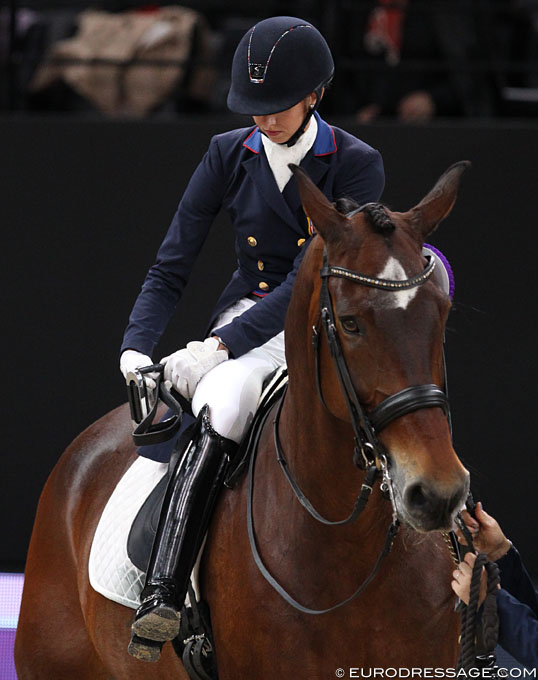
Victoria advises that if the stirrups get too long, and the rider is not flexible enough through the hips, they are at risk of not being able to keep the lower leg stable, and the lower leg will slide forward.
As Kyra Kyrkland says, “many riders think that a longer stirrup leather makes a better dressage rider. However, when the leathers are too long, you end up with a leg that is too straight, and you can’t sit around your horse anymore."
In principle, because the horse’s barrel is round, you can’t sit with lower leg contact without bending the knee. You can find the correct angle of the knee if you stand on the ground with your feet the width of your horse and bend your knees. As a general rule, you want to bend your knees so that the top of your knees are in line with the tip of the toes. This then creates the all important triangle of stability.
“Weight is directed vertically down the stirrup leather and so the stirrup leather stays vertical and so does the line from the knee to the toe. The vertical line from the knee to the toe and back to the ankle closes a triangle which is called the triangle of stability because is it the foundation that stabilises the seat in all gaits and in all paces," Richard Weis wrote in The Posture Does The Riding.
The Saddle and Its Importance
If 62% of riders with chronic pain identified their saddle as a contributing factor, what can be improved in the design and fitting of saddles?
“First, the saddle fitter needs to be qualified, “ says Victoria. “At least a masters saddler qualification, and beyond that it is great if they also have a wider equitation education and/or coaching qualification. This ensures they are able to analyse the rider’s position, and must see the saddle on the horse while he is moving.”
Swedish saddle fitter Maria Hallring says saddles have been designed without awareness of how the underside of the pelvis actually looks, and how to load it ergonomically.
“There is no knowledge about the 4 different shapes of pelvis, how it affects sitting, and how different types of hip socket and femoral head conformation alters riders ability to actually sit and to drop the leg,” says Maria.
According to Hallring, the old military saddles placed riders higher from the horse, and often solved hip problems.
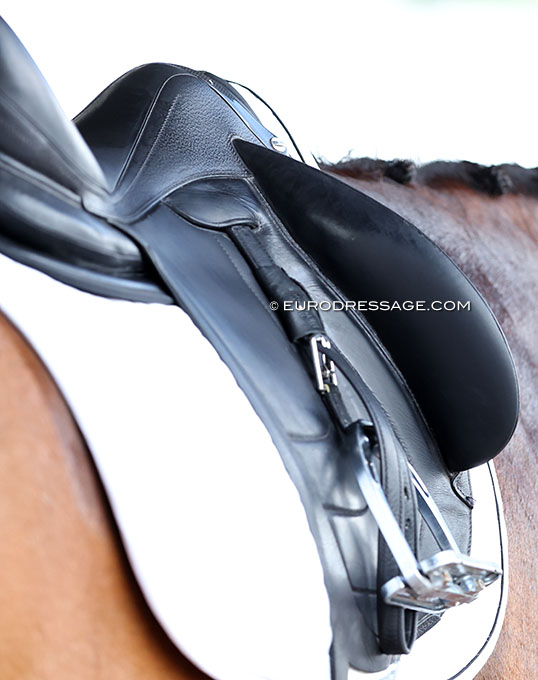
After working with fitting saddle for over 15 years, Maria had learned to fit different top lines, but struggled with the needs of different riders. “I encountered hundreds of riders with different types of pain: hip, groin, seat bones, back, and feet. I also noticed that different riders sat very differently in different saddles," she said.
After ending up sitting in a chair seat herself on the horse, Maria became curious and began to experiment with saddle seat shape.
“I started to look for research in pelvic shapes and how posture functions, and collaborated with physiotherapists and neurologists and this led to the development of the pelvic imprint method.”
Helping people with bad back and disc pain to find relief, Maria understood that pelvic shape as well as femoral head shape was dictating the interface and the stability of both pelvic position as well as spine function.
“Stability of both femure and pelvis lowers the tension in both lumbar and psoas areas. It also activates the core, decreasing tension in the global muscles that should not be involved in stabilising the body, but in controlling motion,” says Maria.
The team went on to discover how the smallest nuance of rider stability, in pelvis, chin, shoulder, thigh, calf and foot, made a very positive difference in the horses balance.
Are Riders Aware of Their Own Crookedness?
“Definitely not,” says Victoria. “In a saddle and stirrup pressure study, we found that riders have a tendency to collapse through the hip on one side of the body. This causes trunk lean, and puts pressure on the contralateral side, so they lean one way and collapse the other. They also showed a tendency to put more weight in the left stirrup, which had no link with footedness or horse cookedness, as tests were done on a simulator. A lot of riders are totally oblivious to how they are sitting. Even when we show them in a mirror off the horse and tell them their right shoulder is much higher than their left, they are very surprised."
Victoria continued, “We need to make riders aware of what they are doing, because unfortunately riders do not have good body awareness.”
Victoria believes that elite riders have very good awareness of the straightness of their horses, but not whether or not they themselves are straight. Beyond this, and the bigger issue, riders are not aware of just how much this lack of body asymmetry is contributing to the welfare of their horses.
Can Technology Help?
Lewis suggests we need to use the technology more to help show riders what asymmetry looks like, and more importantly, feels like in the saddle. “Pressure-mapping systems, rein-tension sensors, motion capture technology, and wearable sensors are becoming increasingly accessible,” says Victoria.
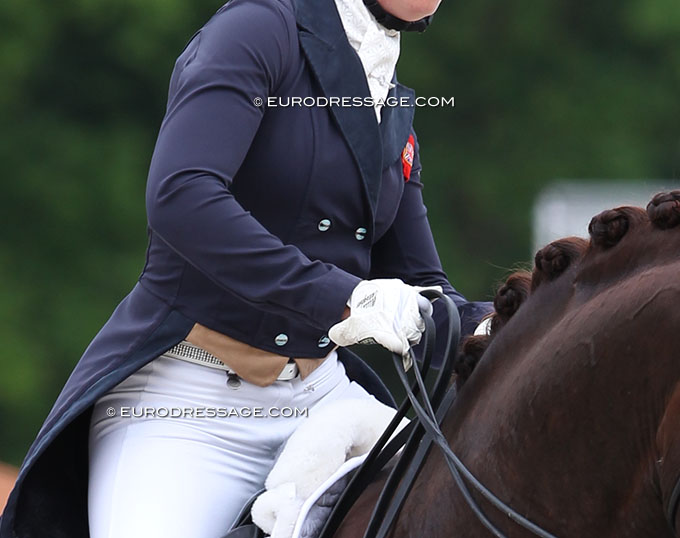
“Physiotherapy type treatment combined with strength training. There are so many professionals now specialising in rider movement and conditioning. Horse sports are way behind other sports.”
I wondered if joining standardised group training can actually have a negative effect if it isn’t tailored to that person and their body and limitations.
“I think anything to improve strength and conditioning can help. But yes a lot of people say ‘you need to go and do Pilates’ but of course you need to do Pilates well and actually address your imbalances if it is to be beneficial," says Victoria.
The Forgotten Welfare Issue
It is important to remember that rider symmetry is not just a contributor to chronic rider pain, but is also a major horse welfare issue.
“A huge contributor to horse wellbeing is improving rider strength and conditioning,” Lewis said. “Whatever you can do to ride better will improve horse welfare.”
Indeed, if an asymmetrical rider consistently loads one side of the horse more heavily, applies uneven rein pressure, collapses through a hip, or struggles to maintain an independent seat and legs, the horse must compensate. Over time, those compensations may contribute to discomfort, altered movement patterns, reduced performance, and potentially injury.
For Lewis, this represents one of the most significant welfare challenges facing the industry. “Riders are woefully unaware of the impact they are having on the horse through unbalanced and asymmetrical riding.”
For decades, dressage has invested heavily into improving the horse’s straightness, symmetry, and athleticism. Yet research suggests many riders are competing with chronic pain, poor movement patterns, and significant asymmetries of their own.If the horse is only as balanced as the rider sitting above him, perhaps one of the most important welfare advances available to the sport is improving the rider’s body—its symmetry and functionality in and out of the saddle. Because we cannot expect to correct the horses imbalances until we first correct our own.
Photos © Astrid Appels
Related Links
Classical Training: Working Seat, Collected Seat, Hard Seat, Classical Seat?
The Harmonious Seat: What is it exactly? Why is it so important? And how can it be achieved?
Christoph Hess: "The Most Important Part of Training a Horse is Training the Rider's Position"
Classical Training: Working on the Seat
A Quick and Inexpensive Way to Improve your Seat, Body Awareness, Symmetry and Relief from Chronic Pain
Classical Training: Putting the Horse in Balance