-- Text and Photos by Silke Rottermann for Eurodressage
This article is a continuation of: Burgtagung 2026: Uta Gräf on Riding Forward-Downward
Puffing my way up the small ascent from the Burgtagung parking lot to the Riding Club Leiningerland on a humid and misty Sunday morning in February and still affected by a nastily persistent virus infection, I remembered that the weather was pretty much the same two years earlier when this proximate event took for the first time at the 2024 Burgtagung.
The keynote speakers for the practical seminar were German classical dressage icon Anja Beran training Germany’s successful Grand Prix rider Uta Gräf. This meeting looked like a clash of opposites for some at first glance, turned out to be a huge success in 2024 and called for a repeat.
Bridging the Gap: Competition Riders vs Home-Staying Classical Riders
Bridging the gap between competition riders and so-called classical riders sometimes seems impossible. While one group has no interest in the other, some classical trainers use the regrettable and obvious degeneracies of dressage competition to market their own business as the alternative.
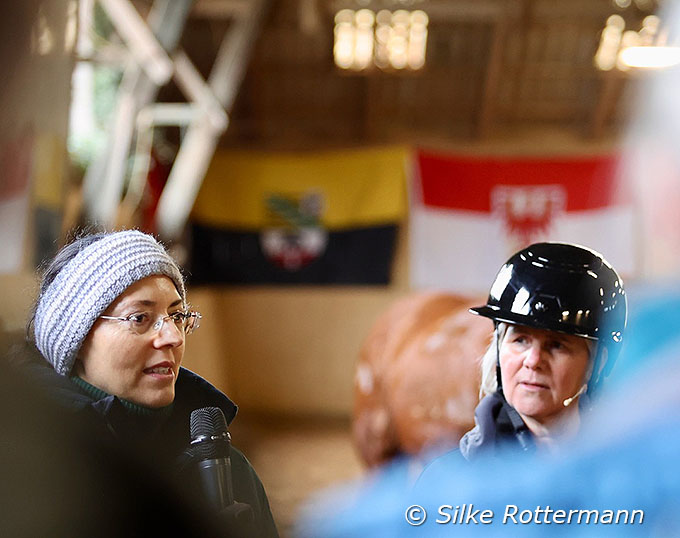
Also in this second edition of the practical seminar at the 2026 Burgtagung the two ladies working together turned out to be a fruitful collaboration and an educative one for the audience, which came from near and far to experience such a rare coming together of two equestrian worlds.
"This is Herzi and he is utterly wonderful"
The day before the event I had a short chat with Uta in the stairwell of the fortress, where she told me she would bring a new horse to train with Anja whom she thinks the world of. I have known Uta for 15 years now and she is a very positive person, but I also know she is realistic about her horses’ potentials. So I was quite curious to see this horse the next day, which apparently sets her heart aflutter.
The first thing which came to my mind when I watched Herzenswunsch being hand-walked in this tiny indoor arena stuffed full of spectators, was that this is a relaxed horse with a good brain. It was soon proven when out of the blue the sound system came to life and produced those high pitched deafening noises at full blast when a system is broken. While Anja Beran who stood next to me in the corner covering her ears, Herzi did not even flinch and continued walking with a long neck next to his groom.
Uta entered the indoor and in her usual style saying hello to the large audience as if they were long known acquaintances. The now 55-year-old Gräf has this innate talent to instantly connect with people and make them feel like friends, a rare and important treat in a person and clinician of that format.
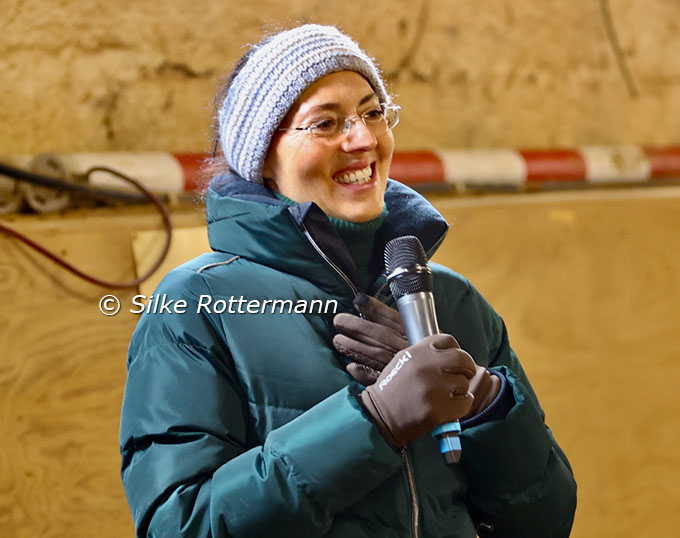
When the audience broke out in laughter for the first of many times to follow, Uta added with a smile that during a clinic with German national coach Monica Theodorescu a few weeks earlier in Warendorf "the other riders enviously couldn’t standing anymore hearing how cute and uncomplicated Herzi is."
Warm-Up: Allowing Time To Seek The Contact
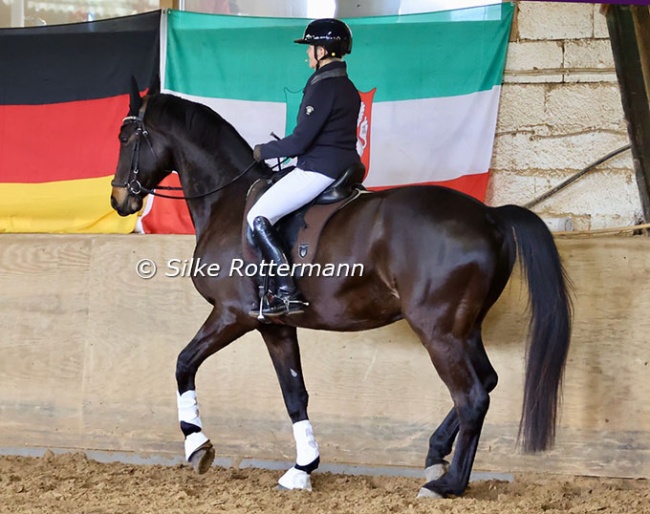
After the horse had been extensively hand-walked, Uta started the warm-up phase in trot. Right from the start Herzenswunsch displayed a kind of trot which I asked myself how many gears it has. The leggy gelding immediately picked up the rhythm and moved very diligently without any tension and in a wide frame, though with a tendency to get a bit tight on his own accord.
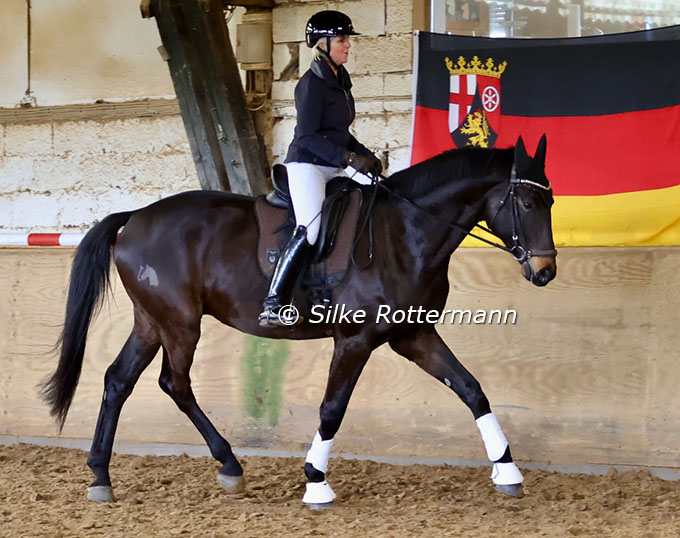
and soon shows a nice forward-downward frame
However, Anja’s infamous eagle eyes could not be blinded the same way and she asked Uta to ride a bit more with the inside leg "so that he does not fall on the right shoulder.s It is these tiniest details which the Bavarian based Beran sees in an instant and which in the end make the difference between very good and superior results. Uta put advice into practice, not without laughing "Anja, you are so nit-picky, it is you who is a real dressage rider," prompting laughter everywhere.
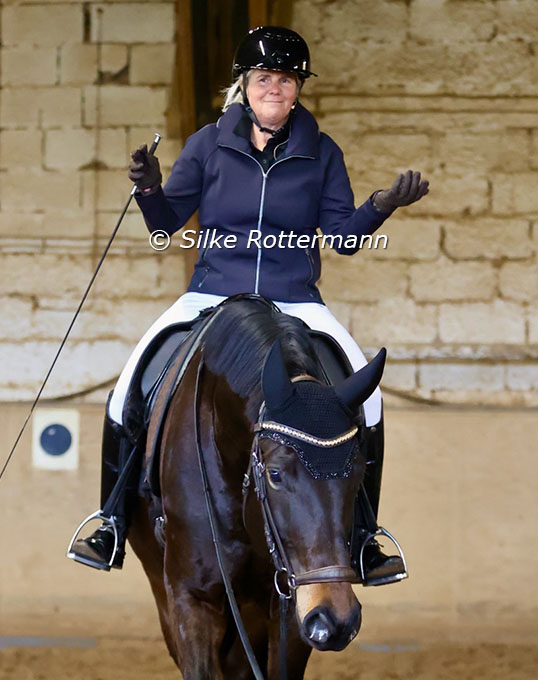
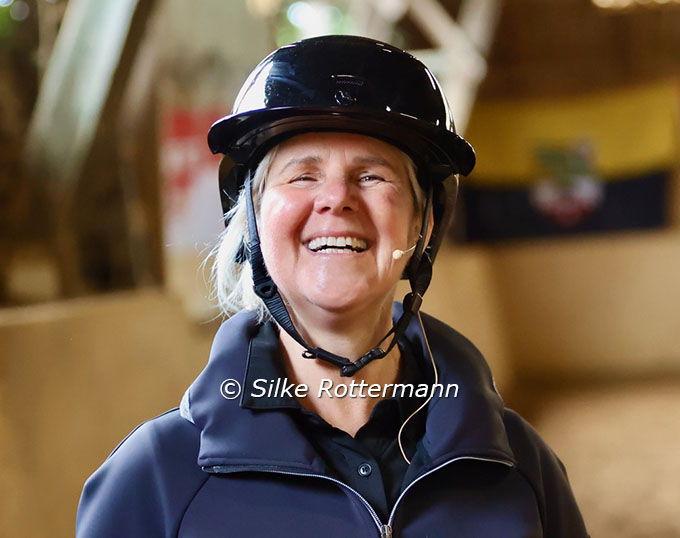
repeatedly speechless
Uta continued the warm-up phase by riding several transitions between canter and trot in what she also became renowned for during her international prime some decade ago: The copybook forward-downward frame all her horses are able to show.
No matter if in trot or canter: Uta never interfered with her horse’s natural rhythm and tempo, resulting in a relaxed horse with no negative tension. The proof in the pudding came at the end of this quite exemplary warm-up phase. When Uta remarked that the horse now feels relaxed, she changed to walk. Herzi immediately picked up the walk rhythm and marched beautifully with totally given reins and a long neck, not batting an eyelid at the many spectators who applauded generously.
Working-Phase: Riding Transitions To Prepare for Collection
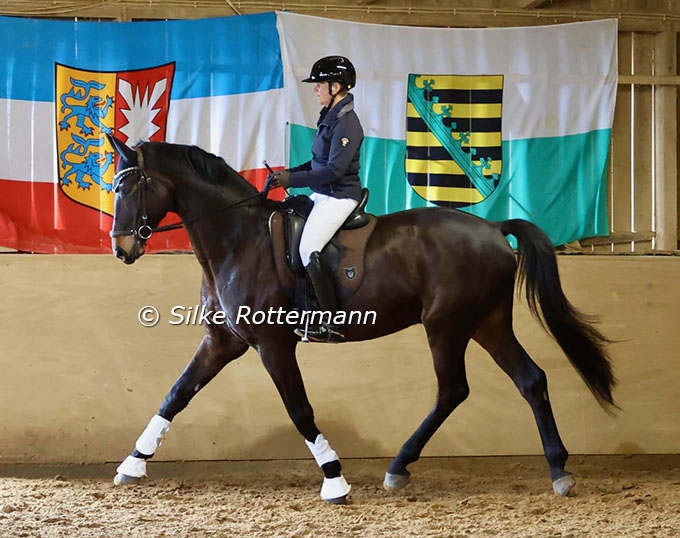
Uta told us "this is the only thing I still need to take care of with this horse" and it did not look dramatic at all. Anja Beran, who likes to work with visuals, made everybody aware that the effect is still detrimental to the exercise. "Uta, you have to take care that his neck does not come deeper in the downward transition. He has to stay up in the poll because only then he comes down behind. If the poll comes down, the hind-legs remain straight. To avoid the drop in the poll just imagine you are ride the transition forward-upward.“
The fun you get watching two riders of that quality working together is that Uta is able to immediately put very precise advice into exemplary successful practice, which proves that the basic training is correct otherwise a horse could not be corrected in such an instant. With tiny adjustments the next downward transition was executed with the horse up in the poll and in front of the vertical, prompting Anja to say, "Very good. Now we can see that he begins to take weight behind."
Working-Phase: Tiny Steps To Aim For The Perfect Piaffe
At the beginning of the lesson Uta had told the audience she would again like to profit from Anja’s undoubted expertise in piaffe and passage work after it had turned out to be really helpful two years earlier for another of Uta’s horses.
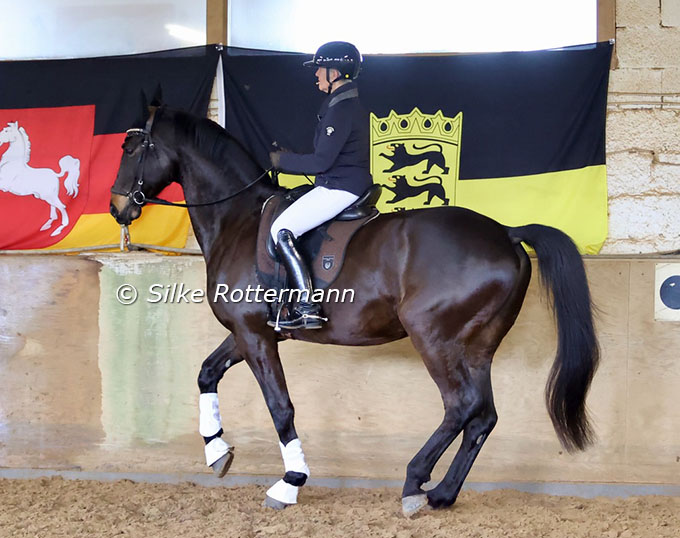
"Perhaps we could also begin with passage today as I like to have somebody from the ground watching if I start that movement," Uta described of what she would like to work on with the invaluable help of Anja.
It is no secret that piaffe is a movement which horses can easily be spoilt for life if too much is asked too early or wrongly. The absolutely fatal results are visibke overall on a horse’s mental state: it shows disgust for the movements again and again, no matter if in top sport or elsewhere, where personal ego and incompetence unite at the horse’s expense.
What is so great at a seminar like this is that a bigger audience sees and gets the idea how a correctly developed piaffe looks like. Not only from its technical execution, but also from the mental state of a horse that is relaxed. Both factors are equally important and were clearly Beran’s focus when she began advising Uta.
From 'Counted Walk' to Piaffe
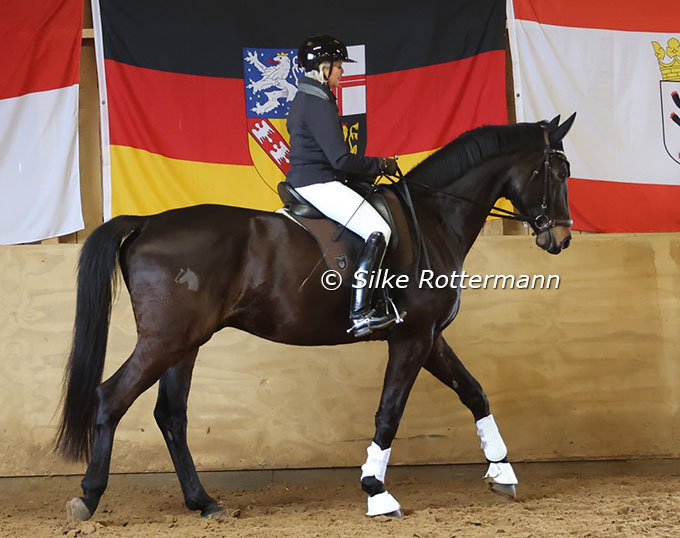
"Counted walk" is a term from academic riding many moons ago when horses were almost (short) ponies compared to the modern warmbloods. In the end it is nothing more than an extremely collected walk. With a correctly trained horse, also our modern warmbloods are able to show it and Herzi had no trouble tackling it.
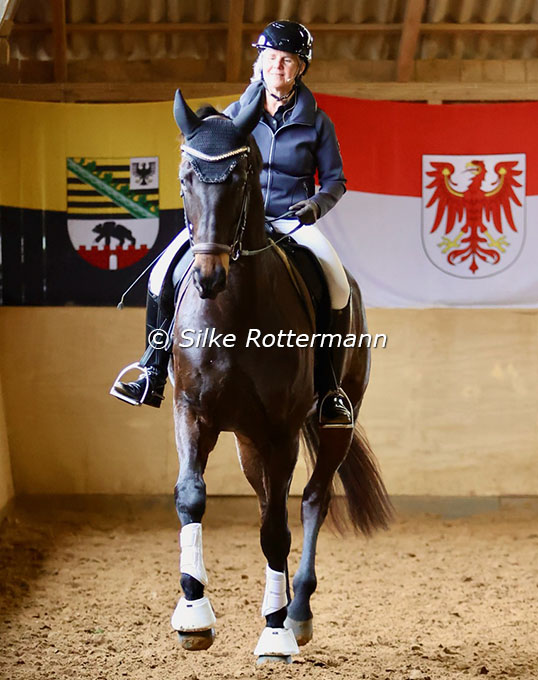
With a light connection and in an admirable self carriage the tall gelding put one foot after the other like in slow-motion until he fell into diagonal steps. It was fascinating to observe how this young horse never got tense, remained extremely focused and started to piaffe as coming from a mental state of deep relaxation.
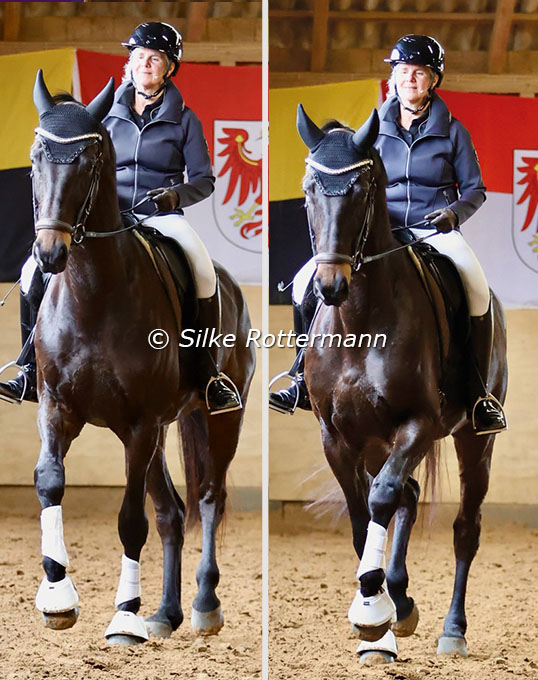
Gräf attempted a few steps of piaffe several times on both leads of which one was of exceptional quality, the horse in a perfect frame and connection, pushing off with very elevated steps, soft like a feather and like in slow-motion, prompting Beran to shout enthusiastically, "this was the very best attempt because the front-legs were straight and very uphill. But also the walk before was very very good. Who cannot ride a good collected walk, cannot piaffe well because both are interrelated."
Whereas Uta did not interrupt the horse until after a few steps, Beran was happy with one, two good steps and also asked Uta to be. She was pointing out something super important which is a real trap in piaffe training, resulting in piaffes with the horse leaning more or less badly on the forehand. "Your horse is super willing, but he still needs more strength. If you ask too many steps, he starts to lean on the forehand as a result. I know one tends to ask more because it is possible, but the strength is still missing to do so."
Working-Phase: Short Work-Outs And Variations
No matter how talented or willing a horse is, it became clear one should not stick too long to one exercise, may it be because the horse offers it so voluntarily, like Herzi did, or may it be because a horse does not show progress and the rider feels the need to force it.
"It is always good to ride something different after the piaffe exercises and never stick too long at one thing," Beran said while Uta started to ride some single flying changes, after which she gave the horse the reins completely in walk and Herzenswunsch marched on, remaining as cool as a cucumber, an impression for the onlooker which Uta confirmed. "He’s so relaxed and super cool, but at the same time he is in a good way wide awake and with me."
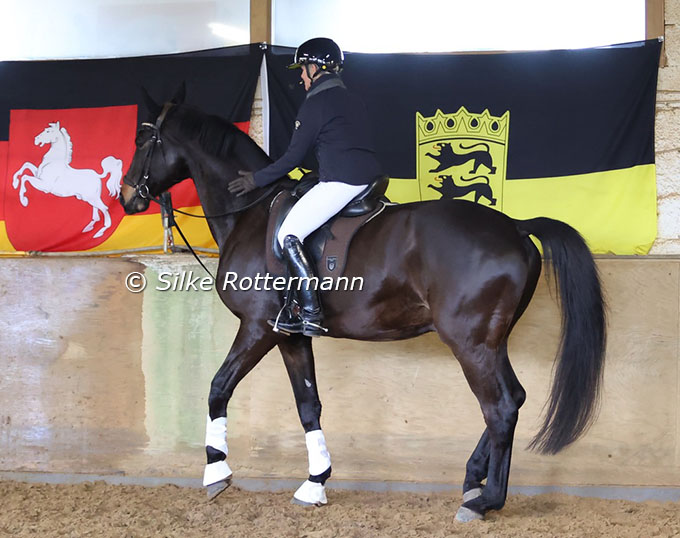
After a walk break Uta suggested tackling the passage and asked Anja how she usually does it. "I often develop the passage by releasing the piaffe forward. That is the way I would do it if somebody has so much talent like your horse," Beran explained. However at the same time she warned that "I always look that the piaffe is a bit confirmed. Otherwise, if you put the horse from the piaffe forward and he does it and gets praised, the danger can become real that a horse (the next time) does that on his own after 2, 3 piaffe steps because it is easier for him (than remaining in piaffe). But we can try it."
gets immediately praised
Listening to Beran’s explanations it became crystal clear which two different types of trainers both ladies are. One with an x-ray vision and academic to the tiniest detail, the other more practical in her approach, relying on her exceptional feeling as a rider.
However, the opposites lead to the refreshing banter between both women that had already stamped their first cooperation two years previously and continued to do so again this time.
Before Uta and Herzi approached the first passage step together, Anja reminded her that "when you release your horse from the piaffe forward you have to wait what he offers you and reward the slightest attempt so that he knows in which direction we want to go."
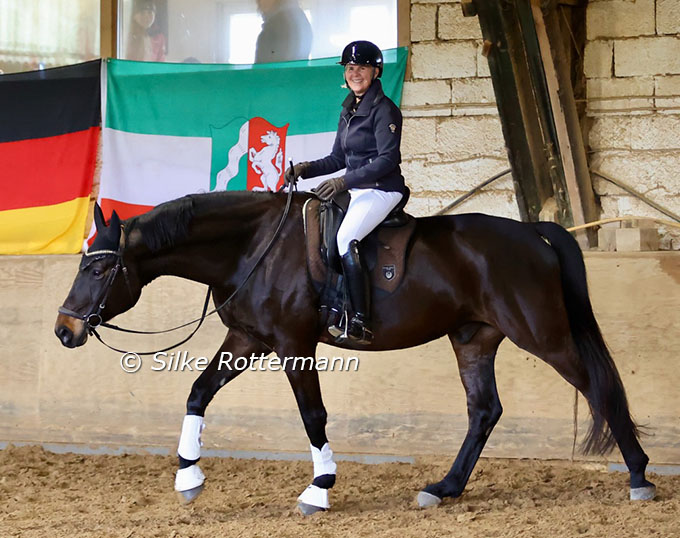
On the second attempt the horse fell even quicker into passage, causing Anja to remark that if the horse offers a step, one should immediately stop and praise in order to make the horse aware what we want of him.
Work With Delight
After a very successful training session, Herzi was untacked in the indoor and started his cool-down walking rounds, while Anja and Uta were open for a Question & Answer session which was surprisingly quiet. Apparently the outstanding talent of the horse who lived up convincingly to each single demand of the day did not raise any questions.
Anja Beran took that as an opportunity to remark that "we want to help riders and with a horse like that they perhaps do not see enough because they do not have such a horse at home. So the learning effect is less." Uta agreed in principle, but replied, "I think we should also show how easy it can be done. At the moment dressage competition is a bit „uncomfortable“, but to train such a horse and compete with him is no problem at all."
Beran got into it and addressed the audience by saying "we need to train horses who are less talented just in the same way, relaxed and playful. It just takes a longer time. Be happy with tiny steps and give the horses the same delight and motivation."
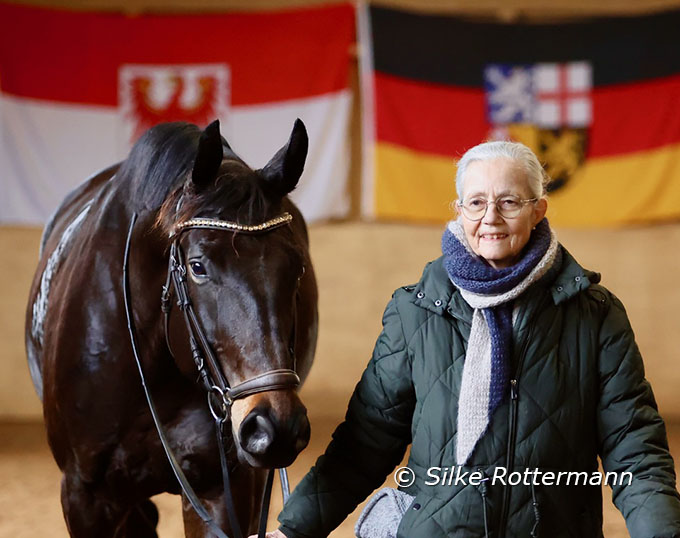
Uta confirmed that she trains each horse with joy, but that she also takes care if she doesn’t feel like it and then also stays away from the saddle for a few days. "It is what is sometimes lacking in some clinics. Riders are now and then getting in their own way instead of enjoying their horse," Uta remarked; something Anja has also experienced in her own clinics. „Riders often fixate on what is not yet possible and the horses sense it, instead of being happy what is already possible," she said.
The essence of the event? Dressage is systematic work with a great necessity for tiny details, but it still should be fun for horses and riders alike. No matter the talent of the horse, it always needs to be approached in a playful way and focus on what horses can do, instead of niggling them relentlessly with what they still have a hard time with.
The guideline of all work has the be the one of the Cadre Noir’s chief rider General L’Hotte (1825-1904): "The horse has to return to the stables as happy as he has left them."
Related Links
Burgtagung 2026: Uta Gräf on Riding Forward-Downward
Burgtagung 2026: The Way is the Goal - Which One Leads to the Future of Competition Sport?