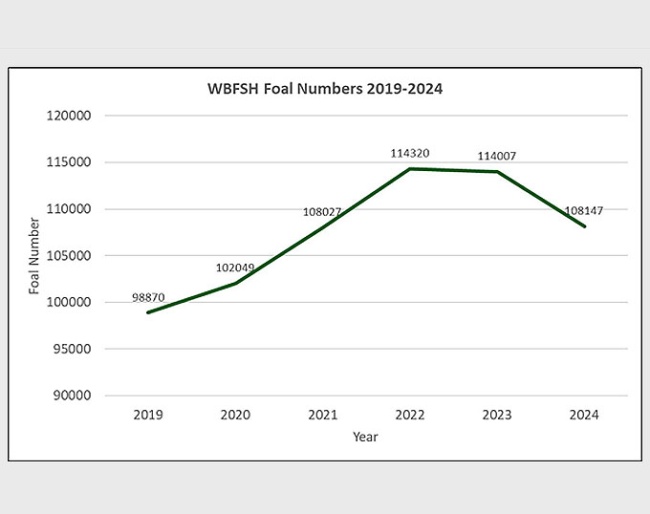
The World Breeding Federation for Sport Horses (WBFSH) has reviewed the foal numbers in the period 2019 - 2024 in its state of the industry report for 2024-2025.
"Foal numbers are a useful proxy for breeding activity and wider industry confidence, as they reflect both breeder intent and the ability of the market to absorb future youngstock," the WBFSH communicated. "Particular attention is given to years in which breeding activity may have been disrupted by external conditions, and to whether the subsequent pattern suggests stabilisation."
Key trend from the data
- 2019–2020: broadly stable (c. 100,000 foals across WBFSH studbooks)
- 2021: a marked step-change upwards (to 108,027 foals)
- 2022–2023: continued growth and relative plateau (peaking at 114,320 foals in 2022)
- 2024: a modest correction (to 108,027 foals), still materially higher than 2019–2020
Interpretation
The recent trajectory is likely influenced by a combination of macro and sector-specific factors. Breeders and studbooks have been operating against a backdrop of economic pressure and uncertainty, including political instability in key regions, alongside rising operating costs—notably veterinary care, feed, land, and general overheads.
Even with these headwinds, the overall picture remains positive: foal numbers rose strongly after 2020, held near a high plateau through 2022–2023, and while 2024 shows a dip, it continues to reflect a level of breeding activity well above the pre-2021 baseline, suggesting that underlying demand and breeder confidence remain comparatively resilient.
While some of the 2024 easing may still reflect lagged COVID-era effects, inflationary pressure, higher input costs, and wider geopolitical and geoeconomic uncertainty are likely to become increasingly important drivers of breeding decisions as the sector moves further away from the pandemic period.
Foals Outside Europe
Non-European foal numbers show a relatively steady underlying trend over the period, despite the range of economic pressures and market disruptions experienced in many regions. While some countries saw short-term softening, the overall pattern suggests a gradual recovery trajectory rather than sustained decline.
A key factor raised by stakeholders was the disruption to breeding inputs during the pandemic period, including one to two seasons where the import of frozen semen was minimal or effectively halted in parts of the world. Given the natural lag between covering decisions and recorded foal registrations, these interruptions would be expected to flow through into subsequent foal crops, helping to explain temporary dips and the later, slow return toward normalised levels.
Key Takeaways
Europe remains the core engine of WBFSH foal production, with registrations heavily concentrated in a small number of major countries (notably Germany, the Netherlands, Spain, Belgium and France).
The period is characterised by a clear post-2020 step-change, most visible from 2021 onwards, followed by two comparatively stable high years (2022–2023).
The 2024 easing is widely viewed as a combination of timing/lag effects from the COVID period and mounting external pressure from inflation, higher input costs, and wider geopolitical / geo-economic uncertainty; as the industry moves further from the pandemic, these latter factors may become the more important drivers of breeder confidence and output.
Outside Europe, registrations are smaller in absolute volume but concentrated in a few programmes (USA, Brazil, Australia) with additional contributions from Canada, Chile, New Zealand, South Africa, China and Mexico; overall volumes remain above 2019.
Reporting completeness matters: late or zero returns in some countries can understate the final year total, so small year-on-year changes should be interpreted with appropriate caution.
Brazil is the standout growth case within the non-European dataset, with foal registrations rising from 767 in 2019 to 1,806 in 2024—more than doubling over the period. No other country in the dataset shows comparable growth. This may reflect more intensive use of assisted reproductive techniques, alongside market conditions that appear less constrained by the economic pressures affecting some other regions.
Related Links
PRE Studbook Sees Small Growth in Number of Foals Registered in 2025
KWPN Reports Drop in Foals Registered in 2024
Grey Tonic and Diamantenglanz Top Ranking of Most Coverings and Foals in Westfalia in 2025
Extreme U.S., Most Popular KWPN Breeding Sire of 2024 - Most Foals Born in 2025
Devin Franco GJ, Most Used Dressage Breeding Stallion in Sweden in 2025